


- Home
- Companies
- Durridge Company, Inc.
- Products
- Durridge - Soil Gas Probes
Durridge - Soil Gas Probes
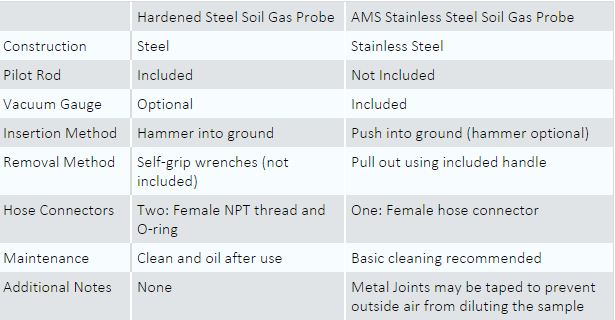
When measuring radon underground, it is essential to collect samples without exposing them to the outside air. We offer two heavy-duty soil probes for this purpose: the Hardened Steel Soil Gas Probe, and the AMS Stainless Steel Soil Gas Probe. The specifications of these two soil gas probes are listed below:
Probe Placement and Connection
DURRIDGE`s Soil Gas Probes operate anywhere above the water table, preferably in soil containing few stones. A pilot rod is hammered most of the way to the depth required, then removed and replaced with the drive rod inside the probe. Once it has been hammered down to the required depth, the drive rod is removed, creating a channel through which soil gas may flow upward.
The soil probe may be connected to the RAD7 by either pushing the plug-in hose connector into the probe, or screwing on the NPT hose connector. Tamping down the soil around the probe prevents the leakage of fresh air into the sample acquisition path or down the outside of the probe to the sampling point.
The Soil Gas Probe may be used in conjunction with the laboratory drying unit and the DRYSTIK, using the supplied plastic tubing.
Modes of Operation
There are three modes of soil gas measurement. One is by obtaining a sample in GRAB mode; another by continuous monitoring using the standard protocol; and the third by operating the RAD7 in THORON mode.
If necessary, the soil gas sample can be pumped out of the ground by a sampling pump, and fed to a Tedlar sample bag for later analysis by the RAD7.
Continuous monitoring is a simpler method of measuring the soil gas radon concentration and provides time resolution in the event that the weather changes. In this protocol, the RAD7 will pump for the first five minutes of every half-hour cycle, and then for only one minute in every five, once the relative humidity drops below 10%. After two hours of continuous monitoring, this would amount to 20 L, which would come from a sphere around the sampling point of around 6" (15 cm) radius. Less porous soils would have a slower flow rate, so the volume of soil gas sampled would be less.
Thoron protocol uses 5-minute cycles, during which the pump is run continuously, to accommodate the short half-life of thoron. This mode produces an approximate indication of underground thoron.