- Home
- Companies
- emka Technologies S.A.S
- Products
- easyTEL+M1 - Telemetry for Rodents
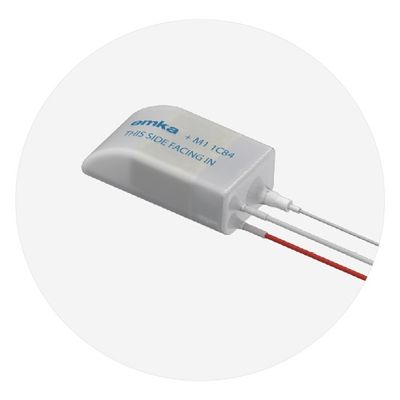
easyTEL+M1 - Telemetry for Rodents
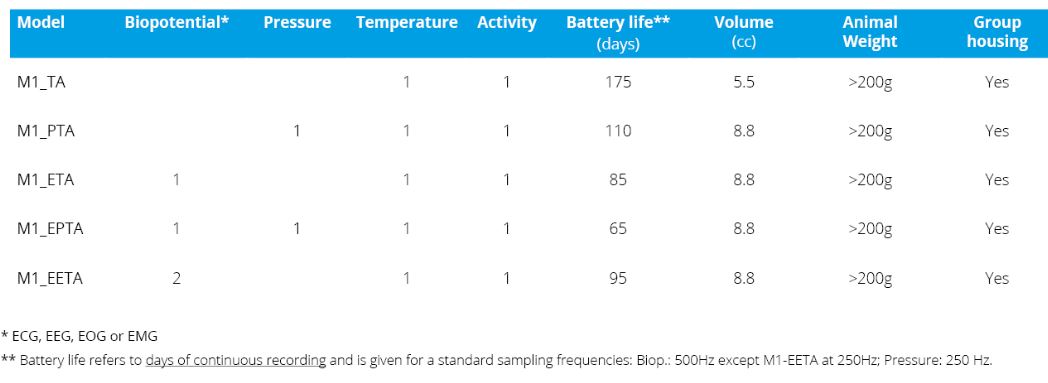
easyTEL+ is a fully implantable digital system, that transmits physiological data from conscious freely moving laboratory animals. Intended for use in preclinical research (primarily toxicology, pharmacology and safety pharmacology studies) and biodefense, the easyTEL+ implants are ideal for rodents > 200g such as rats. Various models offer the ability to continuously record Biopotential (ECG*, EEG*, EMG*, EOG*), Blood pressure (Arterial and/or Left Ventricular Pressure), Respiratory rate**, Temperature and Acceleration.
*Electrocardiogram (ECG), electroencephalogram (EEG), electromyogram (EMG), electrooculogram (EOG)
**Derived from pleural or blood pressure or diaphragmatic EMG

This page lists techniques and measurements employed by the easyTEL+ system for rodents, and used in the area of measuring cardiovascular, neurological and respiratory outcomes.
- Physiological measurements are captured, amplified and digitized by a transmitter surgically implanted and wirelessly transmitted to a receiver within 3 to 5 meters distance.
- When received by the telemetry receiver, physiological signals can directly be sent to the acquisition computer, via Ethernet.
- Communication between implants and receivers is bidirectional, allowing data collections, but also implant remote control (implant state (on/off), settings and configuration).
Electrocardiogram (ECG), electroencephalogram (EEG), electromyogram (EMG) or electrooculogram (EOG) signals can be retrieved using digital telemetry easyTEL+ through implanted electrodes. Various configurations are available:
Single lead biopotential, using a 2-wire electrode:
To get 1-lead ECG, or 1 EEG, EOG or EMG. For ECG, Lead II placement is usually chosen (but not necessarily).
Dual biopotential:
To get a 2-lead ECG or a combination of 2 biopotentials amongst 1-lead ECG, EEG, EOG or EMG.
Unipolar configuration, using 3 wires electrode:
In this configuration, the reference electrode is common to both biopotentials.
Unipolar biopotential is easier for the surgery but both biopotentials must be similar (2 EEG or 2 ECG for instance).
- Biop 1 = Electrode 1 – Electrode 2
- Biop 2 = Electrode 3 – Electrode 2
Bipolar configuration, using 4 wires electrodes:
In this configuration, the biopotential is measured between the positive (red) and
negative (white) electrode, allowing to get two independent biopotentials (EEG and
EMG for instance).
- Biop 1 = Electrode 1- Electrode 2
- Biop 2 = Electrode 3- Electrode 4
For ECG, lead III can be deduced by the software from leads I and II.
ECG : wave duration, amplitude, ST elevation, QT correction , arrythmia detection,
HRV analysis.
EMG : Temporal and spectral analysis
EEG :
- Sleep scoring
- Epileptic seizure detection
- Spectral analysis
EOG : Temporal and spectral analysis
Intra-arterial measurement of Blood Pressure (BP) is the preferred technique for BP measurement because of the ability to directly measure BP over an extended period. Implants intended for blood pressure acquisition are equipped with a catheter that will be inserted in an artery (femoral, carotid for example).
- Systolic
- Diastolic
- Heart Rate
- Mean pressure
- Duration of breath
Breathing rate can be retrieved from easyTEL+ implants through:
- Blood pressure low frequency variations
- Pleural pressure frequency
- Diaphragmatic EMG low frequency variations
A 3-axis accelerometer inside the implant measures the acceleration in the x-, y- and z-axis.
Any movement of the subject head translates in variations in the x, y, z coordinates of acceleration.
Using the three individual axis signals, IOX2 acquisition software calculates a global acceleration, making it possible to derive information about the animal’s posture (standing on hind legs, on its side etc).
The easyTEL+ implant houses a cutting-edge sensor that continuously monitors core body temperature with a resolution of 0.04°C.


Basic digital system
- A typical setup includes implants, receivers, an Ethernet switch and an acquisition computer.
- A single ethernet cable provides power and data transmission between the receiver and PC. Cameras can be added for synchronized video recording.
- Head-mounted system for rats can be added to the same setup.
Combined behavior tracking system
Adding an easySYNC device to the basic system allows to track and analyze the behavior, movement, and activity of an animal in Noldus EthoVision software while synchronizing physiological data from easyTEL+ telemetry system. Learn more.