


- Home
- Companies
- Ecomax Engineering
- Products
- ECOMAX - Ultra Filtration System
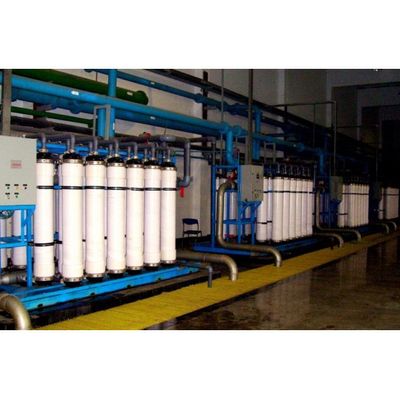
ECOMAX - Ultra Filtration System
Ultrafiltration is a method of membrane purification of a liquid, during which a solution under pressure is passed through a filter capable of passing only certain components. Due to the difference in the molecular weights of the solute and the solvent, as well as different pressures on both sides of the membrane, water is purified from impurities. Molecular compounds to be removed from the solution remain on the other side of the membrane and do not pass through the filter.
Ultrafiltration purification of liquids is based on a principle similar to reverse osmosis. Forcing the solution through a fine-mesh membrane with a hole size of 0.005 microns removes up to 97% of iron, up to 99.9% of bacteria, viruses and up to 100% of suspended solids. When water passes under pressure through the membranes, the following processes occur:
- deferrization;
- reduction of color and turbidity;
- removal of organic impurities (suspension and colloidal solutions).
Ultrafiltration of water is a baromembrane process, during which liquid is forced under pressure through a semi-permeable membrane, which ensures high quality of fine purification and optimization of microbiological parameters (TMP). Filtration systems are based on polymeric hollow fiber membranes designed to retain particles up to 0.1 microns in size. The purpose of ultrafiltration units is to improve the quality indicators of the liquid before desalting. To increase the efficiency of fine cleaning, it is recommended to preheat the water to + 20–25 0C.
The technology of water purification with ultrafiltration membranes has been known since the late 1990s. It has found wide application in the food, microbiological and chemical industries. The main purpose of use is water treatment and preliminary purification before supplying liquid to reverse osmosis or ion filters. Ultrafiltration systems are most in demand in the following industries:
- pharmaceutical production;
- textile industry;
- production of dairy products;
- paper making and processing;
- metallurgy;
- petrochemical industry;
- leather production, etc.
The process of separating high- and low-molecular components of the solution is also necessary for the effective purification of wastewater, which, together with reverse osmosis and desalination units, makes it possible to organize a recycling water supply system at the enterprise. Also, the stations are recommended for the creation and reconstruction of wastewater treatment systems, since they increase the level of environmental safety of wastewater and the economic efficiency of industrial enterprises. Also, household ultrafiltration is widely used - a technology for disinfection and clarification, which allows you to abandon the treatment of water with coagulants (substances that can adhere particles of a dispersed phase in a colloidal solution). This method of purification, unlike reverse osmosis, does not change the salt composition of the liquid, ensuring the removal of only organic compounds, viruses and bacteria.
Membrane water purification from protein and organic fine-dispersed impurities replaces long-term processes of settling, sedimentation and microfiltration. Ultrafiltration technology involves the passage of a liquid under high pressure through membrane modules, standard sizes (filtration area) and the amount of which affect the final cleaning result and the plant performance. Membranes are divided into several types depending on the following characteristics:
- structure (there are single and multichannel fibers with an inner diameter of 0.8 mm or less, but fibers with an inner diameter of up to 1.5 mm are used to treat water with a high concentration of suspended solids);
- flushing technology ("inside - out" or "outside - in");
- material of manufacture (polysulfone, fluoropolymer, polyethersulfone, etc.).
Typically, membranes are produced in the form of plates of microporous organic materials, roll elements for additional purification of water with a turbidity value of up to 0.5 mg / L, or tubular elements used with a turbidity value of up to 40 mg / L. Hollow fiber tubular membrane filter cartridges require periodic replacement as their dirt holding capacity is limited. But the structure of the module allows for regeneration (cleaning and reusing the element). Affordable price and multiple use have made these types of filters the most popular. It is also important what the membrane is made of. The material of manufacture determines the hydrophilic, hydrophobic properties and the nominal molecular weight cutoff. For production, mainly polymeric materials are used, such as:
- polyvinylidene fluoride;
- polyethersulfone;
- recovered cellulose acetate;
- polysulfone;
- composite fluoropolymer;
- polyacrylonitrile;
- hydrophilized polysulfone;
- polyimide, etc.
To restore the performance of membranes from the listed materials, special solutions are used. Backwashing is performed to remove sediment from internal surfaces. Solutions are prepared on the basis of hydrogen peroxide, sodium hypochlorite, hydrochloric acid and sodium hydroxide. They are safe for polymeric materials, but it is important to choose the right concentration, taking into account the molecular composition and thickness of the sediments.
Ultrafiltration (membrane purification of water under pressure) occurs in various modes: dead-end, tangential, in direct coagulation mode using inorganic reagents, etc. Depending on the equipment operation scheme, the advantages and scope of ultrafiltration systems may differ. So, the dead-end mode of operation, in which there is a periodic discharge of pollution and regeneration by reverse current, has become widespread due to the low cost, simple equipment circuit and low energy consumption of installations operating on this principle. If a chemically enhanced backwash occurs, the operating pressure of the equipment is reduced, and the filtration system operates in an automatic mode and does not require operator participation. To save space, a compact, fully closed loop pressurized ultrafiltration system is recommended that does not expose the operator to harsh odors and chemical vapors. Regardless of the scheme of operation, the ultrafiltration membrane purification system has the following advantages over alternative water treatment plants:
- effective cleaning from impurities at pressures up to 2 atm .;
- reduction of consumption of water consumed by 2 times;
- reduction of the cost of the purified liquid by 5 times;
- high-quality disinfection (removal of up to 99.9% of pathogens);
- reduction of electricity consumption by 2 times;
- chemical and temperature resistance of membranes;
- high automation of the cleaning process;
- favorable cost of treatment equipment.
Ultrafiltration units provide the best water quality in terms of turbidity, color and oxidizability. Immediately after cleaning, it is suitable for consumption and retains useful trace elements in its composition. The treatment plants are compact and easy to maintain, and are also optimal for the preparation of drinking water from surface sources.