- Home
- Companies
- Sollau s.r.o.
- Products
- Sollau - Model ECS-C RAM - Eddy Current ...
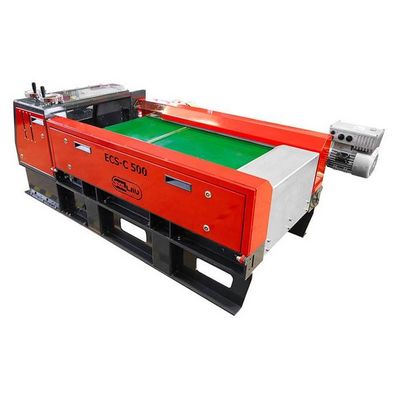
Sollau - Model ECS-C RAM -Eddy Current Separator / Non-ferrous Metals Separators
The version with a magnetic rotor having 4 poles laid centrically. With its speed of approximately 3000 revolutions/ minute it is designed to separate bigger and lighter material fractions (e. g. separation of aluminium beverage cans). In the case of high-frequency rotating (6000 revolutions/minute) a high level of reliability of separation of even the materials crushed in a finer way is achieved. ECS separator of non-ferrous metals works on the principle of so called eddy currents. From where also its assumed marking „eddy current separator“ comes. Very quickly rotating magnetic poles create the versatile and short magnetic field magnetizing every conductive particle occuring in its outreach for the limited time. Magnetic polarity of the particles magnetized in this way is the same as polarity of the magnetic field created by rotor of separator. That is why the magnetized materials are repulsed and thrown away automatically out of the conveyor strand.
Design of the separator for non-ferrous metals
This separator consists of up to three prnciple modules
- Module with a magnetic rotor (1)
The modul being delivered standardly is the middle one (1) with the magnetic rotor having the extremely strong neodymium magnets embedded in the driven roller of belt conveyor. The rotor sheating, which the induction roller is positioned in, is made of a special non-magnetic material with fibreglass content. The beginning feeding module (3a/3b) and the final assorting module (2) belong to the optional accessories. - Feeding module (3a/3b)
Beginningfeeding module ensures partly pretreatment of the material and also its correct and uniform spreading on the conveyor strand of the separator. This is a key condition for an optimum level of separation especially at middle-sized and fine material fractions. The beginning module is recessed with e. g. magnetic drum (3b) or magnetic roller or also magnetic plate above the conveyor-belt to catch the ferromagnetic particles or with the vibrating feeder (3a). - Assorting module (2)
Final assorting module ensures the comfortable splitting of the material fractions assorted. It is a box with a deviding barrier that can be translocated either axially or in pre-set distances according to magnetic characteristics of the materials being assorted just at that moment. The magnetized and non-magnetic parts of the material can be separated from each other very exactly in this way.
Except the feeding and assorting module we deliver a control box with PLC control system, touch screen etc. as the optional accessories.
Conditions to ensure the correct functionality of separators for non-ferous metals
Owing to the fact that the outreach of magnetic field at this type of separator is rather short, the distribution of the lowest layer of the material on the conveyor strand of the separator has to be taken into cosideration. And it is in such a way so that the height of the material being on the conveyor corresponds to the material fraction approximately and creates a monolithic mono-layer. The material should fall preferably in the loosened condition on the conveyor. All of this can be achieved e. g. by a vibration feeder or other special elements ensuring good spreading of the material on the conveyor.
In the case of the versions with the rotor embedded centrically there is a high risk of damage of the conveyor by a ferromagnetic particle caught by magnetic field of the rotor even also at the roller itself. That is why there is a need of noting rigorously separation of Fe particles before the entrance of the material on the conveyor strand especially at the centrical versions. Use magnetic drum, roller, plate or a combination of these to separate the unwanted metal particles
Deviding the materials based on their suitability for separation
Generally it is valid that the higher electric conductivity and volume of the individual pieces being separated is the bigger distance exists to which the material coming out of this separator is thrown away to. That is why e.g. pieces of aluminium can be separated more easily than short thin wires.
Well separable materials
These separators are ideal for the continual automatic separation of well conductive light non-ferrous metals (as for example copper, aluminium, magnesium, silver etc.). They are usable with certain limitations also to assort objects made of brass, zinc, gold, cadmium or tin.
Materials inconvenient for a separator for non-ferrous metals
On the contrary separators based on eddy currents cannot be used for separation of heavy or poorly conductive metals (stainless steel, lead, platinum, titanium etc.). The magnetic field the materials with a low electric conductivity in a minimum or even no extend and that is why they fall upright down by the effect of gravitation at the end of coveyor.