


- Home
- Companies
- EL-DI GmbH
- Products
- EL-DI - Electro-Deionization Cells ...
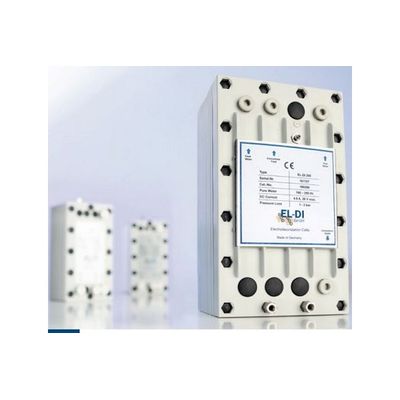
EL-DI - Electro-Deionization Cells (EDI) Technology
To produce high-purity water, the use of electro-deionization cells (EDI) has been established over the past 25 years. The desire to do without regeneration chemicals for post-treatment systems (Ion exchangers) of reverse osmosis systems pushed the spread for the use of this Technology.
As a result, ion exchangers were increasingly displaced as polishers for external regenerations. The EDI cells mean that DI cartridges do not need to be changed, so loss of quality of the product water is avoided.
- This guarantees a constant water quality.
- The operating costs are reduced.
EDI cells remove the ions from the water to be treated, which is typically achieved by reverse osmosis plant or other processing systems.
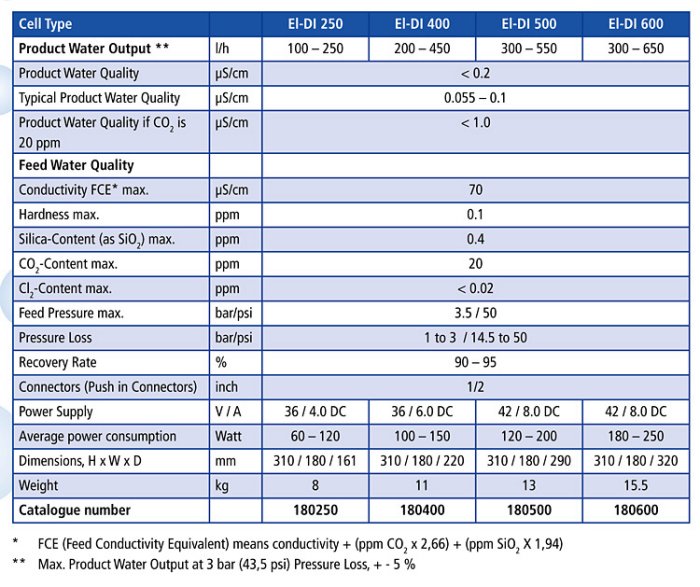
The EL-DI cells produce ultrapure water with a quality of up to 0.055 μS/cm, equivalent to 18.2 MΩ . cm. The cells work continuously or intermittently, as required.
The process of our cells was first presented in 1996 at the Aquatech in Amsterdam during the Ultra-Pure Water Conference.
Summary of advantages of EL-DI cells over ion exchangers
- EL-DI cells work continuously and do not require any interruptions in operation for regenerations or exchange of DI cartridges.
- They deliver constant quality.
- You do not need any chemicals for regeneration.
Summary of advantages of EL-DI cells over mixed-bed cells
- They are currently the most compact and efficient cells on the market.
- There is a high tolerance for high CO2, FCE of 100 μS/cm, and more is possible.
- They require significantly less energy than other cells.
- They are operated with low voltage and therefore do not require any personal protection against electric shocks.
- You do not need to rinse the electrodes or provide a circulation pump.
- In many cases, degassing and / or pH increases can be avoided.
- TOC content 3 - 5 ppb when feed is < 100 ppb.
- Germ reduction > 99 %.
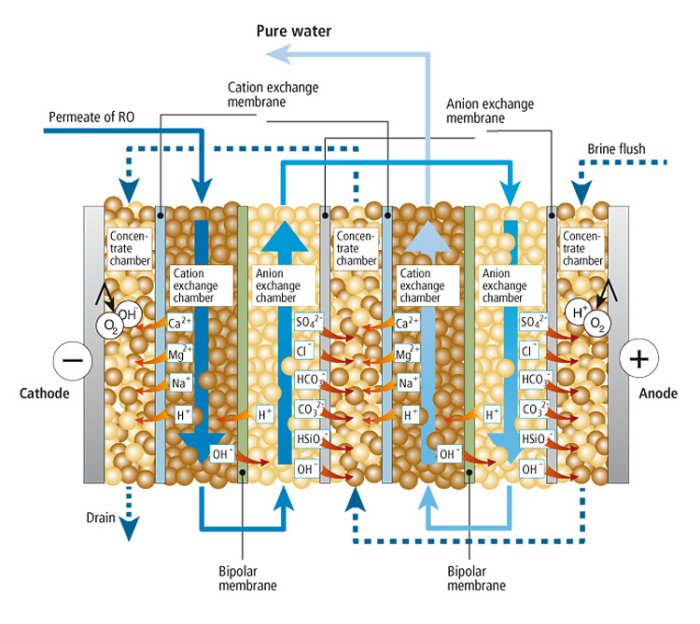
The permeate from the reverse osmosis system is fed into the cell under a pressure of up to 3 bar. Here it flows through the first cation exchange chamber, where approx. 90 - 95 % of the cations are removed. Then it flows over both anion exchange chambers. Here the anions are removed to 99.99 %. Then it flows over the second cation exchange chamber. Here the remaining cations are removed to 99.99 %. The cations and anions are transported through the ion exchange membranes into the brine chamber by the DC current applied to the electrodes. A partial flow of the permeate, 5 - 10 %, is passed through the brine chambers to divert the separated ions. The mode of operation, first through the cation exchanger and then through the anion exchanger, ensures an improved separation of silicates.
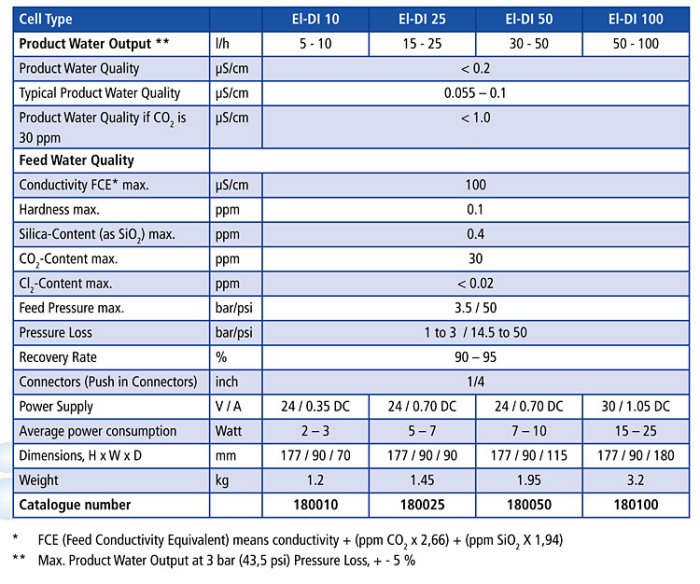
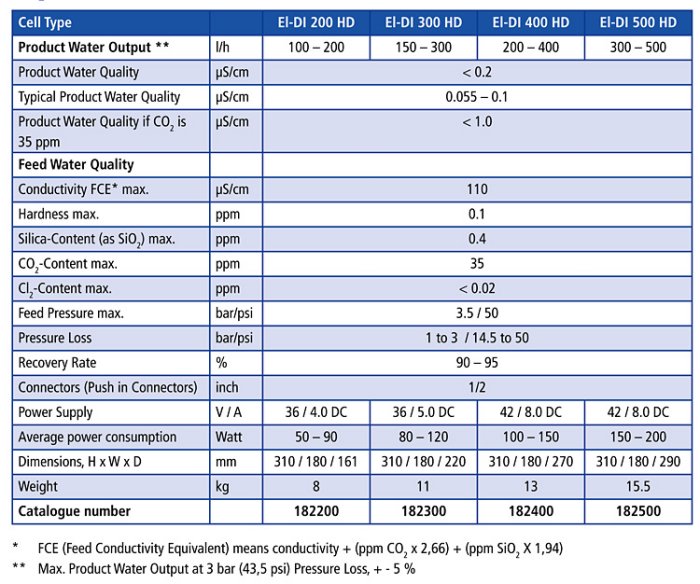
The areas of application of the EL-DI cells are broad. Wherever the water quality from reverse osmosis systems is not sufficient, it can be improved by integrating an electro-deionization cell to ASTM type II.
Water from El-DI cells is suitable for the following examples:
- Clinical analysis.
- Clinical and other automatic analysers.
- Ultrapure water systems.
- Autoclaves.
- Steam generators.
- Humidifiers.
- Rinsing of laboratory glass vessels.
- Buffer and media preparation.
- Industrial washing processes.
The illustrated flow diagram with RO and EL-DI cell shows one example of many possible integrations. It is supposed to show how easy it is for the EL-DI cells to be integrated.