
- Home
- Companies
- Industrial Scientific
- Products
- Industrial Scientific - Electrochemical ...
Industrial Scientific - Electrochemical Gas Sensors
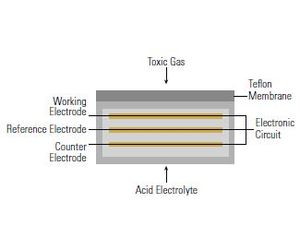
Electrochemical sensors are widely used in the gas detector industry. Learn to understand the technology. The basic components of an electrochemical sensor are a working (or sensing) electrode, a counter electrode, and usually a reference electrode. These electrodes are enclosed in the sensor housing in contact with a liquid electrolyte. The working electrode is on the inner face of a Teflon membrane that is porous to gas, but impermeable to the electrolyte.
The gas diffuses into the sensor and through the membrane to the working electrode. When the gas reaches the working electrode, an electrochemical reaction occurs; either an oxidation or reduction depending on the type of gas. For example, carbon monoxide may be oxidized to carbon dioxide, or oxygen may be reduced to water. An oxidation reaction results in the flow of electrons from the working electrode to the counter electrode through the external circuit; and conversely a reduction reaction results in flow of electrons from the counter electrode to the working electrode. This flow of electrons constitutes an electric current, which is proportional to the gas concentration. The electronics in the instrument detects and amplifies the current and scales the output according to the calibration. The instrument then displays the gas concentration in, for example, parts per million (PPM) for toxic gas sensors and percent volume for oxygen sensors.