


- Home
- Companies
- SnowPure Water Technologies
- Products
- SnowPure ElectroPure - ...
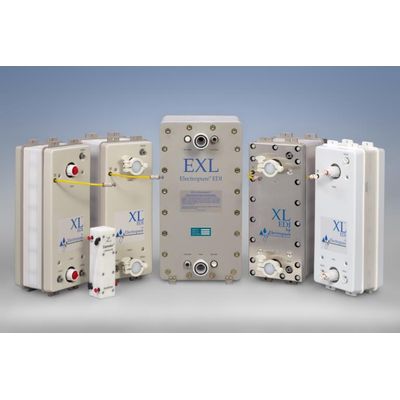
SnowPure ElectroPure - Electrodeionization Technology
Electropuretm EDI technology has fundamental advantages and differences from other EDI products. There are similarities to other EDIs, but Electropure EDI has 4 major technical advantages.
EDI is a continuous membrane deionization process in which a DC electric field is used to remove charged ions from an aqueous stream. EDI is used with reverse osmosis (RO) to replace ion exchange resin mixed beds (MBDI), which require onsite or offsite chemical regeneration.
… uses no chemicals, generates no hazardous waste, and makes ultrapure water continuously.
There are four innovative key technical advantages in Electropure EDI. These enable Electropure modules to have higher efficiency and longer life, with less maintenance and fewer problems.
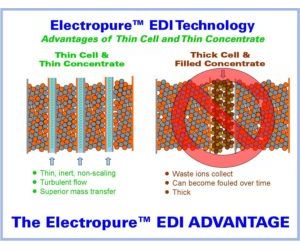
Electropure EDI has always had the advantage of thin cells. In EDI, there is a physical competition to drive ions horizontally out of the cell before they leave the top of the cell. Electropure XL cells are 4mm wide, as compared to Ionpure and E-Cell which have cells about 10mm wide. This allows higher quality and higher efficiency.
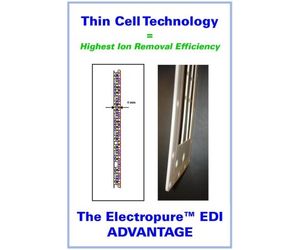
Electropure EDI uses a very thin insert screen, about 700 microns thick. It is woven with very thin fibers. This design creates turbulence at the membrane surface, keeping the membrane surfaces clean, and close to pH 7 preventing fouling and scaling. The thin design also keeps the current low.
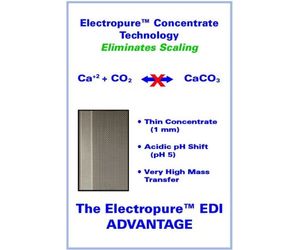
Electropure avoids the use of a “filled concentrate” which can foul. The all-filled design was patented by O’Hare in 1981, but we rejected its use because of its long-term problems (fouling).
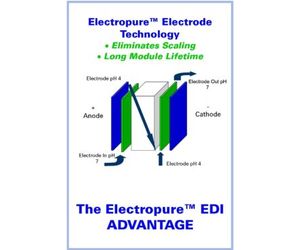
Electropure EDI uses a proprietary design which keeps the electrodes always on the acidic side, preventing scaling in the electrodes. It also uses a special anode technology to limit the production of chlorine, which lengthens the life of the EDI module.
- Enables a simpler system (no concentrate recirculation)
- Produces ultrapure water (up to 18.2 megohm.cm)
- Eliminates regeneration chemicals and hazardous waste
- High recovery, up to 99%
- Single unit capacities ranging from 1/4 gpm to 44 gpm (60 l/hr to 10 m3/hr)
- Multiple unit arrays up to 6000 gpm (1400 m3/hr)
- Compact, durable, long-lifetime patented design