- Home
- Companies
- Advanced Cyclone Systems, S. A. (ACS)
- Products
- ReCyclone - Model EH - Electrostatic ...
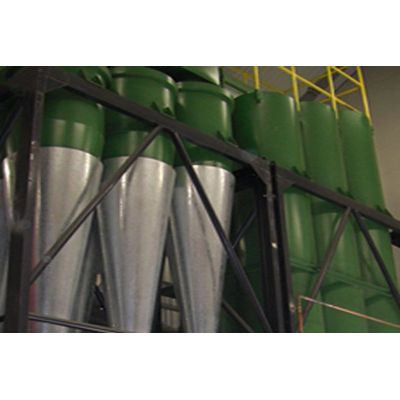
ReCyclone - Model EH -Electrostatic Recirculation Cyclone System
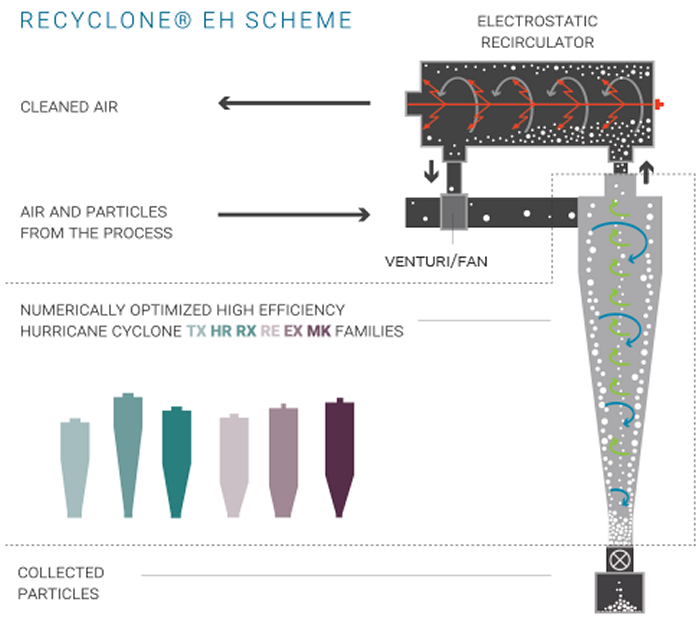
Recent adoption of electrostatic recirculation in the same cyclone system has successfully proven to further reduce particle emissions, even in the [1;5]μm particle size range, assuring future regulation compliance, particularly where legal limits are very strict.
A DC high voltage is applied to the recirculator, allowing the recirculation of very fine nanometric particles, more resistant to centrifugal forces, to the cyclone collector. After having been separated in the recirculator and concentrated in the recirculation flow, electrically charged fine particles are attracted by the cyclone walls, while agglomerating with larger particles entering the system – both promoting their easier capture.
Since particles are not captured on the walls of the recirculator, contrary to ESPs, ReCyclone® systems avoid the problem of dust accumulation and condensation.
Additionally, ReCyclone® EH systems have low sensitivity to either low or high dust electrical resistivity while the high voltage required power is only 10 to 15% of that used in ESPs.
Electrostatic recirculation for fine particle capture was the winner of the Portuguese Environmental Press Award in 2008 and nominee for the European Environmental Press Award 2008.
- Very high efficiencies: decreases emissions of a ReCyclone MH by (40-70)%
- "Bag Filter comparable" emissions: (l5-25]mg/Nm3 is achievable for many combustion sources
- Pressure drop: (120-170) mm w. g.
- Operates up to 400°C
- Not sensitive to variable flow rates
- Robust construction with no moving pans (no rapping mechanisms)
- Low maintenance and downtime costs
- Reasonable investment costs