


- Home
- Companies
- Kemix (Pty) Ltd.
- Products
- Kemix - Electrowinning Cells
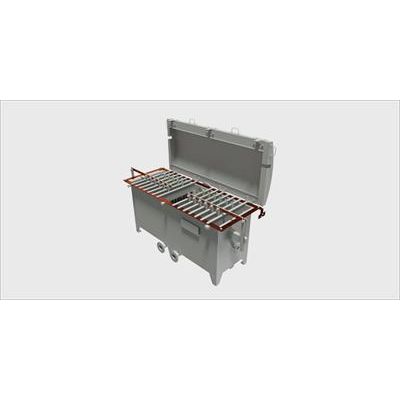
Kemix - Electrowinning Cells
Eluates containing soluble gold and silver from either a ZADRA or an AARL type elution are suitable for recovery in the Kemix Electrowinning cell. Electrowinning is a process used to recover metals (eg. gold and silver) from concentrated solutions by applying a voltage across electrodes immersed in a concentrated solution.
The positive terminal from the rectifier is connected to the anode where the oxidation reactions occur and electrons are generated. These generated electrons are consumed at the cathode which is connected to the negative terminal of the rectifier. The reduction reaction results in the deposition of metal on the cathode. The following electrode reactions take place during electrolysis of an alkaline gold cyanide solution:
- Cathode : Au (CN)¯² + ē¯ → Au + 2CN¯
- Anode : 2H₂O → 4H+ + O2 + 4ē¯
In cyanide solutions, gold is present as a stable auro-cyanide complex anion with a relatively high cathodic potential (E0). The cathodic shift demands a higher cell voltage and consequently other cathodic reactions like the formation of H2 and the reduction of O2 can also occur. These additional reactions consume current and reduce the current efficiency of the gold electrowinning process.
Caustic is required in the electrolyte to firstly maintain the conductivity of the electrolyte and secondly to ensure that the pH value remains sufficiently high thus minimising anode corrosion. The recommended caustic strength in the eluate should range between 1 to 2 % NaOH and the conductivity of the electrolyte should be above 1.7 S/m.
High extraction efficiencies can be achieved at elevated eluate temperatures of approximately 70°C. This is due to a combination of lower dissolved oxygen content, reduced solution viscosity and increased ionic mobility at higher temperatures. However, a maximum electrolyte operating temperature of 90°C can be tolerated in the Electrowinning cell.