


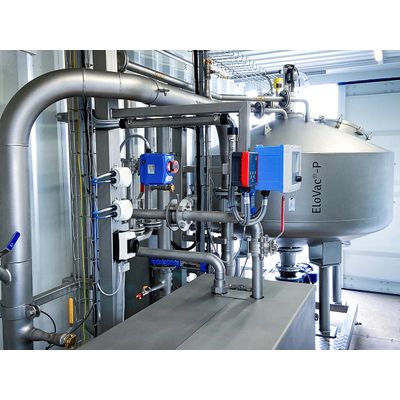
Elovac - Compact, Skid-Mounted Vacuum Degassing Technology for Digested Sludge
Vacuum degassing can also improve the sludge digestion process of the entire wastewater treatment plant. We are currently investigating how vacuum degassing can improve digester performance – for example, sludge density, and thus increase digester capacity while avoiding foaming issues.
How can ELOVAC® improve digester capacity?
- Faster release of the gas from the sludge floccs
- Higher density of the sludge
- Higher amount of biomass in the digester
- Higher sludge age (HRT) in the digester
- Better mass transfer
- Avoid dosing high amounts of defoamer
- Better mixing of the digester
Vacuum degassing on its own can have a significant impact on the carbon footprint of the treatment plant.
Only with the implementation of ELOVAC® the following results were achieved:
- 3 kg avoided CO2-equivalent emissions per cubic metre of digested sludge. In absolute numbers, this means (for a 100.000 PE treatment plant) the avoidance of 410 kg CO2-equivalent emissions or approx. 3,200 CO2-neutral car-kilometres per day (based on threshold fleet consumption car CO2emission 130 g CO2/km.
Additional 0.63 kWH?? per cubic metre sludge from the withdrawn biogas make the operation of ELOVAC® energy positive
Improve dewaterability


- Sludge is fed continuously to the degassing reactor tank via a control valve or a pump
- In the degassing tank, a vacuum pump withdraws the gas present in dissolved form and as bubbles from the digested sludge.
The pressure and the amount of sludge in the degassing tank are controlled to predefined values. - The vacuumed gas enables an energy-positive operation by capturing additional biogas, while reducing greenhouse gas emissions.
- The degassed digested sludge is continuously discharged from the degassing tank to the downstream sludge treatment step, typically dewatering