

- Home
- Companies
- Envicare Technologies Pvt. Ltd.
- Products
- Envicare - Automatic Water Softeners
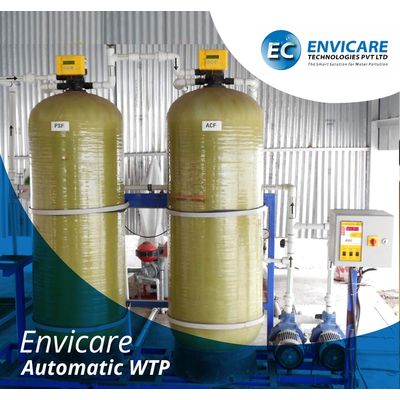
Envicare - Automatic Water Softeners
Water Softening Plants: Water is considered ‘hard’ when it has excessive levels of calcium and magnesium dissolved in it. Hard Water can lead to the following Water problems: Scale build-up in pipes, resulting in decreased flow rates. Scale build-up on heating and cooling systems, leading to increased electricity costs and breakdowns. White film on glass surfaces and staining on Water taps. Increased laundry costs due to hard Water reacting with soap and laundry detergents.
Water softening methods mainly rely on the removal of Ca2+ and Mg2+ from a solution or the sequestration of these ions, i.e. binding them to a molecule that removes their ability to form scale or interfere with soaps. Removal is achieved by ion exchange and by precipitation methods. Mineral tank and the brine tank are the main constituents of the Water softening system. The Water softening system consists of a mineral tank and a brine tank. The mineral tank and the Water supply pipe is connected due to which Water passes through the tank before it can be used. Mineral tank consist of negatively charged beads or resins that attracts positively charged calcium and magnesium.
The surface of the resin gets coated with the calcium and magnesium minerals. The resin is cleared by flushing a strong sodium (salt) solution held in the brine tank. The sodium ions are powerful and they easily overpower the calcium and magnesium ions and drives them off of the resins which is later drained out of the unit.
Chemical Water Softeners:
Chemical softeners are used in laundry. It basically removes magnesium and calcium and thus lengthen lifespan of clothes. However it should be kept in mind that the Water so treated is not fit for drinking.
Packaged Water Softeners:
Packaged Water softeners are infact chemicals used for the softening purpose. There are two types of packaged Water softenersPrecipitating and Non-precipitating.
Washing soda and borax are the examples of precipitating Water softeners. These products upon reacting, forms insoluble precipitate with calcium and magnesium ions. This enhances the cleaning efficiency Whereas, in Non-precipitating Water softeners, calcium and magnesium ions are segregated from the Water through complex phosphates.
- Automatic regeneration
- User friendly
- Require less space
- Low power consumption
- Reduction of scales
- Clogging from pipes and vessels
- Increases the efficiency of appliances and the plumbing Systems.
- Enhances service life
- Light weight & compact
- Anticorrosive parts
- Efficaciously cleanses the harmful particles
- Boiler Feed.
- Cooling Tower Make-Up.
- Air Conditioning Plant.
- Textile Processing.
- Beverage Production.
- Hospitals, Hotels, Laundries etc.
- Food processing.
- Chemical & textile.
- Water power plants.
- Ice plant.
- Dyeing processes
- Pharmaceutical industries
- Product finishing
We design and manufacture very efficient Water softeners that are effective in reducing the hardness of the Water. They help in producing zero soft Water by highly acidic cation exchanger, which removes calcium and magnesium ions from the Water. our Water softener plant is portable, easy to move from one place to another. It also involves less effort in terms of installation and maintenance. As one of the leading drinking Water softening plant manufacturers based in India, we make our products available to our customer’s at the most affordable price range.