


- Home
- Companies
- Envirotreat Solutions Ltd
- Products
- Envirotreat E-Clays - E-Clay Technology ...
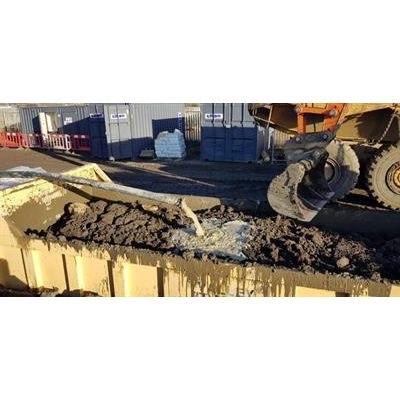
Envirotreat E-Clays - E-Clay Technology for Environmental Remediation
E-Clay Technology is central to Envirotreat`s remediation solutions, leveraging chemically modified Smectite Clays to create a reactive medium adept at pollutant immobilization in soils and water. Over 150 projects have utilized this technology over the past two decades, showcasing its application in stabilization and barrier treatments. The transformation of these clays through Quaternary Ammonium Salts results in organophilic E-Clays proficient at absorbing diverse organic compounds. Additionally, integrating transition metals enhances their reactivity to aromatic hydrocarbons. While conventional QAS organoclays exhibit limited effectiveness with hydrocarbons like benzene, E-Clays employ varied chemical interactions, including Van Der Waals forces and covalent bonding, accommodating mixed waste treatments. Site-specific designs enable broad-spectrum pollutant treatment, further reinforced by the creation of pillared E-Clays.
At the heart of the Envirotreat remediation process is the E-Clay® Technology.
E-Clay have been utilised in circa 150 remediation projects over the last 20 years. The technology has been successfully applied in both Stabilisation and Barrier treatment strategies.
Envirotreat E-Clays are derived from the modification of naturally-occurring Smectite Clays using selected chemical reagents. A reactive treatment medium is produced capable of chemically absorbing and immobilising a range of pollutants present within soils and water.
The addition of Quaternary Ammonium Salts (QAS) to the clay structure produces an inorgano-organo E-Clay. This E-Clay has organophillic properties capable of absorbing organic compounds such as aliphatic hydrocarbons of varying chain length and polarity. The organophilic properties of the inorgano-organo E-Clays are dependant on the degree of QAS intercalation.
The reactivity of E-Clays towards aromatic hydrocarbons and other substituted organic groups is enhanced by the introduction of transition metals to the clay structure. Commercial QAS organoclays have been shown to be less effective in treating pure hydrocarbons such as benzene due to limited reactivity.
E-Clays function using multiple chemical bonding reactions (i.e. Van Der Waals attraction forces / transition metal ligand bonding / dipole-dipole effects, ionic bonding to full covalent bonding and / or molecular alteration) enabling the treatment of mixed waste materials / contaminated soils. Envirotreat are able to design E-Clays on a site specific basis to enable the treatment of a range of inorganic and organic pollutants, in most cases using one E-Clay design applied in a single process.
Pillared E-clays are produced that have the ability to withstand excessive dehydration without loss of stability. Pillared E-Clays contain molecular props creating basal separation within the clay structure. This creates interlamellar spacing sufficient to provide access for larger molecules such as polychlorinated biphenyls and polyaromatic hydrocarbons to be absorbed within the clay matrix.

E-Clays also have the capability to treat both cationic and anionic metallic pollutants by cation exchange and chemical bonding processes with the pillaring complexes. The E-Clays can treat cationic heavy metallic pollutants including copper, lead, nickel and zinc and anionic metallic pollutants including chromates and arsenates / arsenites.