

- Home
- Companies
- Peschl Ultraviolet GmbH
- Products
- MPDSEVO - Falling Film Photo-reactor ...
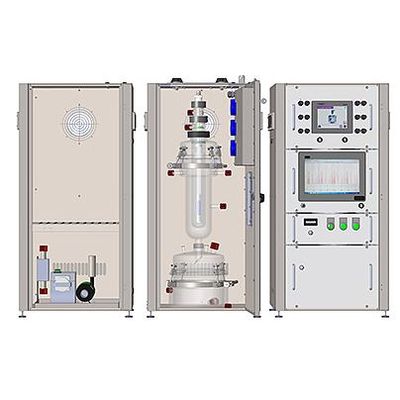
MPDSEVO - Falling Film Photo-reactor Basic Systems
The efficient irradiation of liquids with low transmission (optical permeability) represents a hitherto unresolved challenge in some photochemical processes.
If there is a lack of penetrative depth, photons are absorbed directly at the boundary surface, the optical path of conventional reactors is not utilised, and a direct full absorption and in consequence an inefficient process occurs. Furthermore, and in particular in the case of photolyses and photochemically initiated reactions where radical intermediates are formed, mostly macromolecular secondary products can form which are deposited on the surface of the immersion lamp system (“filming”). These deposits additionally absorb the photons and in extreme cases can lead to overheating of a conventional photoreactor.
The falling film photoreactor from Peschl Ultraviolet GmbH has a special design that permits efficient irradiation of liquids with low transmission in the form of an even falling film with high turbulence and low layer thickness. Deposits on the jacket tube are prevented by the design, as the liquid film does not come into contact with the immersion lamp system.
With the falling film photoreactor the desired turbulence for the exchange of material at the boundary surface has already been reached with a Reynolds number of Re > 400 and requires no high flow rates. The favourable design of the overflow edge prevents tearing off of the film and heavily simplifies levelling. In direct comparison to an annular thin layer photoreactor, the advantage of the falling film photoreactor for liquids with low transmission becomes obvious. The advantageously long residence time in the photoreactor is heavily limited in a thin layer photoreactor by the high flow rate required to achieve turbulence, while in the falling film photoreactor this is considerably extended. This is of crucial advantage for the efficiency of the reaction.
The falling film photoreactor from Peschl Ultraviolet GmbH has been optimised in such a way that the size of the irradiated surface (cm²) in relation to the intensity generated in the distance to the radiation source is ideal for most reactions. Since the immersion lamp system is not in direct contact with the reaction medium, photochemical and thermal polymerisations on the surface of the jacket tube are prevented.
As the falling film photoreactor is a completely closed apparatus, gas diffusion can be simply achieved, gas consumption can be determined and the gas development in a photochemical reaction can be very closely followed.
The photoreactor can be cleaned simply and unproblematically without the use of tools. The reservoir is a component separated from the falling film reactor, so that connections to a wide range of reaction volumes are possible. The falling film photoreactor has been optimised for increased efficiency for the MPDSBASIC system in such a way that it works according to the double chamber principle and the radiation that is not completely absorbed in the falling film is utilised in the head of the reaction medium. The reactor can optionally be supplied with a temperature control cladding through which a reaction can be cooled or heated in the range from -80ºC to +120ºC.
The falling film photoreactor from Peschl Ultraviolet GmbH means that photochemical reactions can now be efficiently carried out even with liquids without appreciable transmission.