


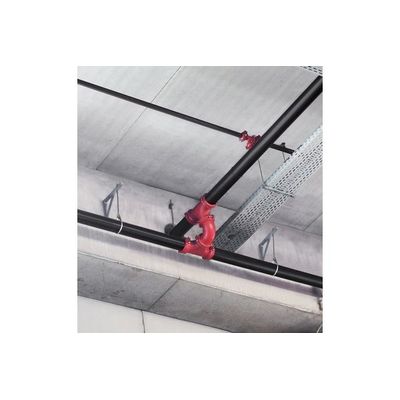
Minimax - Fendium Polymer-Enhanced Steel Pipe
Fendium Polymer-Enhanced Steel Pipe feature a special polymer protecting it against corrosion both on the outside and the inside. They thus achieve a significantly longer lifespan than conventional pipes and increase the functional reliability of an extinguishing system. Fendium also offers many other advantages.
- Low pipe friction allows the use of smaller pipes or smaller pumps in many cases
- Less space is required due to smaller pipes or smaller pumps
- Polymer and steel are unified minimizing the risk of flaking – unlike paint and powder coating
- Quality from the world`s largest pipe prefabrication plant in the fire protection industry
- Available with different levels of polymer protection suited for different corrosive conditions
Rough and constricted pipes, as well as clogged sprinklers or nozzles impair the system`s extinguishing effectiveness in the event of a fire, thus eventually putting people and assets at risk and jeopardizing the continued operation of the business. But even when the suppression system is just in its standby condition, corrosion may cause problems: Leakages may occur not only as a result of rust-through, but also due to roughened surfaces under gaskets of pipe couplings. This means costly water damage and business interruptions. The solution: Fendium polymer-coated pipes. We give our word for it with a 10 year guarantee.
Environmentally friendly manufacturing process
Innovative Fendium pipe is produced at MV Pipe Technologies, a Minimax affiliated company, in the world`s largest pipe prefabrication plant in the fire protection industry. This factory is unique due to its size and the cutting-edge technologies and procedures employed.
After mechanical processing, the corrosion-protective polymer is formed on the outside as well as on the inside of each steel pipe in a patented procedure. After the polymer enhancement the pipe is black – however, by adding an outer powder coating, Fendium pipe can be delivered in other colors as well.
The entire production process is environmentally friendly. All liquids used for surface treatment are water-based and are continuously recycled. Heat and electricity are generated efficiently and sustainably in the internal co-generation unit. The extended lifespan of Fendium pipe also contributes to a reduced environmental footprint.
Durable quality - Polymer and steel are unified
The special Fendium polymer protection is produced in several process steps. After thorough cleaning and pretreatment, the steel pipe to be enhanced is dipped in a tank filled with Fendium polymer emulsion. Iron fluorides contained in the emulsion are continuously supplied to the pipe and provide a release of iron ions on the surface of the steel pipe. As soon as the positively charged iron ions collide with the polymer particles also contained in the emulsion, they adhere to them and partly neutralize their negative charge. The polymer particles are now able to combine with each other and are attracted to the positively polarized steel pipe surface.
In this way, the polymer protection is developed and the pipe’s roughness is smoothed out. Once the desired polymer protection is achieved, this process step is terminated by removing the pipe from the dip tank. To continue the process, gelling takes place in the pre-dryer. The pipe is warmed up causing the polymer particles to run into each other and the pipe to be smoothened further. Finally, the polymer is baked and cured in the hot-air oven. The result of the polymer enhancement is a gradual transition from the steel core to pure polymer.
Fendium pipe can be used for almost all types of water-based suppression systems. It is available with different levels of polymer protection suited to the respective corrosive conditions.
The Basic Series of Fendium pipe are intended exclusively for use in wet pipe sprinkler systems. The Plus Series provide even stronger polymer protection and are therefore also well-suited for areas with greater risk of corrosion, including
- dry pipe and preaction sprinkler systems,
- deluge systems
- low-pressure water mist systems,
- hydrant systems and dry risers, and
- spark extinguishing systems.