

- Home
- Companies
- Finapp S.r.l.
- Products
- Finapp - Neutron Detector Probe
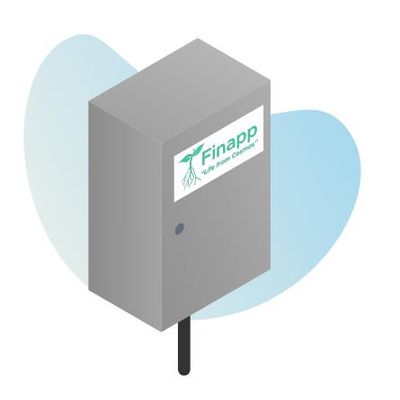
Finapp - Neutron Detector Probe
Cosmic rays continuously reach the earth`s surface: from their interaction with the water molecules present in the soil, in plants, in the snow, a suspended "fog" of neutrons is formed. The CRNS probes (cosmic ray neutrons sensing) allow to count these neutrons and therefore to determine the water content present in the soil, in the bio mass, in the snow.
Why Finapp?
What makes Finapp probes different from other CRNS on the market?
- Use of plastic and metallic materials –patented- that are much easy to find, light, less expensive and bulky.
- Total customizable thanks to its modular design (patented).
- Real time measurement thanks to the on-board measure of the total income of cosmic ray - unique on the market(patented).
- High performance: count up to 3’000 neutrons/h.
- Ecofriendly: we do not use polluting materials or nuclear fission reaction by-products.
Finapp probes can be customized according to customer needs, thanks to our patented modular design. However we have created a catalogue with two different versions, Finapp 3 and Finapp 5, which respond to most of the markets needs. Both versions consist of:
- Patented neutron / muon detector
- A custom low consumption electronic board (about 0.4 Wh)
- Backup battery (14Ah), photovoltaic integrated panel (20W) allow off the grid use
- All contained in a watertight box (IP67)
- The overall size of Finapp 3 probe is: 40x30x20cm, for a weight of about 5kg
- The overall size of Finapp 5 probe is: 50x30x20cm, for a weight of about 6kg
The Finapp 3 is the ideal tool in Agriculture, for knowing the soil moisture thanks to its extreme lightness and compactness. The count of 1,000 neutrons per hour guarantees the performance necessary to have accurate and continuous estimates over time.
The Finapp 5 is designed for more particular uses, such as the areal estimate of the SWE (snow water equivalent, i.e. the water contained in the snow) or of the BWE (biomass water equivalent, i.e. the water contained in the bio mass such as trees or fruit) or to search for water leaks along the aqueducts. For all these purposes, maximum sensitivity is required, which can be reached thanks to a 3,000 neutrons per hour count, without affecting the lightness and compactness of the probe.
Cosmic rays continuously reach the earth`s surface: from their interaction with the water molecules present in the soil, in plants, in the snow, a suspended "fog" of neutrons is formed. The CRNS probes (cosmic ray neutrons sensing) allow to count these neutrons and therefore to determine the water content present in the soil, in the biomass, in the snow.
The CRNS technique has been known for more than 10 years and validated by many scientific publications. But why use cosmic rays to measure soil moisture, BWE and SWE?
Currently available technologies range from invasive, point-scale approaches to satellite remote sensing.
Point-scale approach is generally precise but it is not suitable for covering large areas since the heterogeneity of the soil and the snowpack determine a great variability of the water content even at short distances. A large number of point sensors should be installed, with high installation and maintenance costs, technical problems and interference with agricultural work.
Satellite remote sensing is not suitable for measuring SWE, however it provides soil moisture and BWE observations at a large scale (>km2). Precision is quite low since signal is sensitive only to the very first centimeters of soil or vegetation and the temporal resolution (often weekly) is not suitable for many applications.
CRNS bridge the gap between point measure and satellite with many advantages:
- its large horizontal footprint - tens of hectares - and depth of penetration - 50cm into the soil, more than 10m into the snow
- allows the quantification of soil moisture/ SWE/ BWE averaged over large areas with a single probe
- it is contactless - probe installed 2 meters above the ground / snow - and not invasive. This increases instrument’s life, reduces maintenance costs and facilitates field operations.
- Continuous monitoring, without interruptions due to external factors