


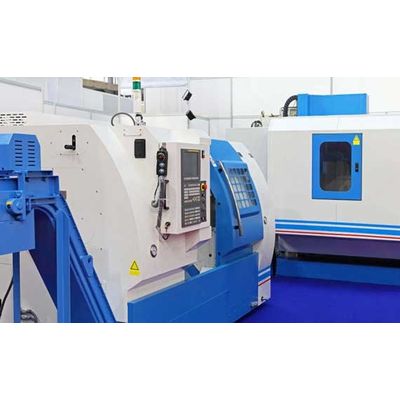
Fire Protection with Argon Extinguishing System
Machining centres for the machining of metals using combustible cooling lubricants represent a significant fire risk in production areas, particularly where the machining of alloys is involved. In addition to the actual working area of the machine, the workpiece transport area and the exhaust air duct are also at risk.
The employers’ liability insurance association “Wood and Metal” established in 2013 that the trend towards using non-water-miscible, combustible cooling lubricants puts more focus on the subject of fire and explosion protection on machine tools for operating companies and insurers. [DGUV Information Sheet 11/2013]. This trend is continuing.
Ignition of the cooling lubricant-air mixture inside the machine tool can lead to intense flame ejection to the area around the machine. Whereas such fire events often result in only light damage, the lack of extinguishing equipment has led to millions of euros of damage and severe injuries to employees in many cases, according to the employers’ liability insurance association. What always happens is longer operational downtime due to damage to the machine tool. The cause for such damage can often be simply a burning chip, spark or a tool that has run hot. Thus the primary objective of every fire protection concept has to be fast fire detection inside the machine and immediate activation of an extinguishing system.
The protection concept of T&B electronic to protect employees and machines from fire and explosion hazards is described below.
T&B extinguishing systems for building protection are designed in compliance with BGI 719 and EN 13478. Fire detection is by means of flame and infrared detectors which monitor all areas of the machine tool. In addition, the extinguishing system can also be triggered by a manual alarm.
A gaseous extinguishing agent is used, since gas – unlike water – can also penetrate concealed areas of the machine, in other words extinguish the flames three-dimensionally. If the source of the fire is behind an obstacle (workpiece, tool etc.), fine mist extinguishers will not guarantee success.
The inert gas argon is the gas preferably used for extinguishing purposes. Its major advantage when used within production areas with operating personnel is that it does not endanger personnel yet still provides maximum extinguishing efficiency. After extinguishing has been completed, it can be simply returned to the environment by ventilation. Any blasts and flames must be directed in such a way that the machine operators are not at risk. The installation of load relieving devices is usually done by the machine tool manufacturer and requires sound specialist knowledge concerning the machine design. The T&B extinguishing control unit BM 4-2G not only detects and extinguishes any fires, it also alerts personnel of the danger through acoustic and visual alarms and monitors the enclosure doors, for example. Thus the machine cannot be put into operation with the doors open, and the extinguishing system is blocked. Detectors and extinguishing agent supply are permanently monitored and operating personnel are warned in the event of a malfunction.
Usually, extraction systems are used to ensure that the combustible cooling lubricant emissions do not become concentrated in the machine tool during normal operation. However, this increases the risk of direct penetration of the flame in the pipeline and the fire spreading to other production areas. For this reason, fast-closing butterfly valves must be installed in the extraction pipes to prevent the fire spreading and close off the machine tool to the extraction system or vice versa in the event of a fire.
T&B extinguishing systems for building protection implement the above-mentioned measures and thus protect machining centres. The gas extinguishing systems are designed in compliance with VdS 2380. Fig. 1 shows the functional principle. Fire detection is by means of thermal and infrared detectors (1, 2) which monitor all areas of the machining centre. In addition, the extinguishing system can also be triggered by a manual alarm (3). When one of these detectors triggers, the butterfly valve (5) is closed via the extinguishing control unit BM-4-2G integrated in the compact extinguishing system (4), the extinguishing agent supply is activated and the extinguishing agent flows into the protected object via the nozzles (6). The acoustic and visual alarm (7, 8) alerts operating personnel.
When argon is used, there is no risk of the gas decomposing even at higher temperatures, unlike CO2. For this reason, argon can even be used for extreme combustion processes such as metal fires. The pressure relief device (9) has the task of reducing excess pressure caused by the ignition of a mixture or the inflow of extinguishing agent into the working chamber of the machining centres. The pressure relief valve is usually installed in the roof area of the machining centres. The employers’ liability insurance association recommends guaranteeing pressure relief as directly as possible, directing flames and hot combustible gases to non-hazardous areas and excluding risks to machine operators.
If a cooling lubricant-air mixture ignites, very high explosive flames can occur when the pressure relief system responds, which is a hazard for the area around the machine. For this reason, no combustible materials (wooden panelling, insulation etc.) may be anywhere near the pressure relief valve. The device only opens briefly and closes again directly once pressure has been relieved.