


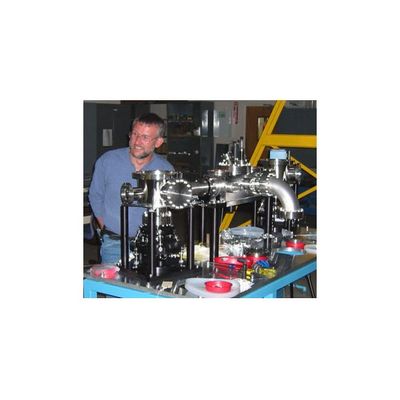
McPherson - Model XCT -Fixed Focus XUV and EUV Monochromator
The grazing incidence X-ray Czerny-Turner (XCT) uses plane gratings and provides fixed focus and fixed slit positions. It is different from Rowland circle systems. Use the XCT with experimental sources that cannot be scanned, and large experimental chambers, like reflectometers. The XCT dual grating rack is standard equipment for wavelength range and resolution flexibility while under vacuum. It can be supplied o-ring sealed for high-vacuum or all metal sealed for true UHV compatability.
This design lends itself not only to fixed slit positions. The geometry can be exploited by using toroidal mirrors (possibly also grazing angle off axis parabolic mirrors) for good point-to-point imaging. It serves well between high harmonic generation laser sources and angle resolved photoemission experiments, for example. When temporal characteristic of the laser source are important, this design is available in an off-plane format to minimize pulse stretching as the diffraction grating rotates to wavelengthof interest.
- Plane, kinematic gratings
- High Vacuum 10E-6 torr (UHV optional)
- Scanning or CCD detection
- Avail. with toroidal optics
- Focal Length : 2m nominal (others selected when HHG source etc. used as sourcepoint)
- Acceptance : 15 mrad
- Angle of Incidence : 82 degrees (8 degrees grazing incidence)
- Entrance & Exit Slits> : Continuously variable micrometer actuated width 0.01 to 1mm
- Grating Mount : 2-position, adjustable in vacuum
- Vacuum Compatible : 10-6 torr (optional metal sealed UHV for 10E-10 torr)
- Gratings : 50 x 50mm substrate
- Wavelength Range : refer to grating of interest for range
The XCT may be used for scanning applications with an exit slit or array detectors (eg. CCD or microchannel plate intensifiers.)
