

KINTO Electrical Apparatus Co., Ltd.
- Home
- Companies
- KINTO Electrical Apparatus Co., Ltd.
- Products
- Flexible Insulated Busbars
Flexible Insulated Busbars
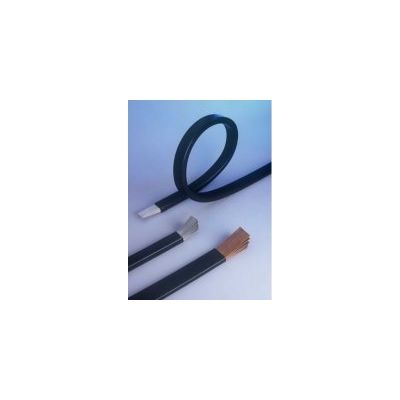
Flexible insulated busbars consist of several layers of uncoated or tinned copper strips and are insulated with flexible high quality PVC compound.
Most popular related searches
- Copper strips (≥99.9%Cu).
- Surface: uncoated or tinned.
- Resistivity: ≤1.785μΩcm2/cm.
- Electrical conductivity: ≥55 Sm/mm2.
- Tensile strength: ≥200N/mm2.
- Extensibility: ≥30%.
- Material: PVC.
- Color: black.
- Thickness: 1.8-2.1mm.
- Shore hardness: A70-80.
- Electrical strength: ≥23kV/mm.
- Oxygen index: 30%.
- Flame retardant; self-extinguishing.
- Elasticity: ≥180% after 7-day aging-test with 135℃.
- Tensile strength: ≥20MPa.
- Operating temperature: -30℃ to +105℃.
- Operating voltage: 750V.
- Voltage withstand performance with 15min / 50Hz AC:
- between flexible insulated busbar and earth: ≥15kV.
- between two flexible insulated busbars: ≥30kV.
- Easy assembly: it could be easily bended and fixed with hands or easy tools.
- Possibility of reducing sizes of the equipment:
- Due to favorable thermal radiation properties, the flexible insulated busbars can handle heavier current loads than solid busbars of the same cross-section.
- Due to good insulating performance of the PVC, it could be possible to reduce the distances between different flexible insulated busbars and between the flexible insulated busbars and earth.
- The bending-radius could be smaller than that of normal cable or solid copper bars, so that the connections could be more simple and short, and visually it could have better effect.
- Lower temperature rise on the flexible insulated busbars than on normal copper bars.
- High flexibility: no problem with vibrations or thermal expansions.