

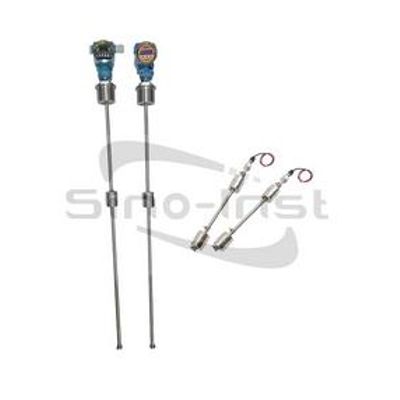
Sino-Inst - Model SI-U01 -Float Level Sensor
SI-U01 float level meter is composed of three parts: magnetic float, sensor and transmitter. When the magnetic float changes with the liquid level, it floats up and down along the duct. The magnetic steel inside the float attracts the reed switch at the corresponding position in the sensor. So that the total resistance (or voltage) of the sensor changes. The changed resistance (or voltage) signal is converted into a current signal of 4-20mA and output. And the upper and lower limit alarms can be set on the display to achieve the position control of the liquid level.
SI-U01 floating ball liquid level gauge consists of a liquid level sensor and an intelligent HART board (current converter). The floating ball and the liquid level change synchronously, and the reed switch is controlled to open and close. This makes the resistance in the sensor change linearly. The change of resistance is converted by the converter into 4 ~ 20mA standard current signal or superimposed HART digital signal output.
- Intelligent electronic components are composed of a motherboard and an LCD screen;
- You can adjust the range and zero point by pressing the button on the spot;
- It can use HART communicator or microcomputer to communicate with this smart meter on both sides without interrupting the output signal. It is suitable for explosion-proof or inconvenient installation and disassembly of the meter. Instrument measurement, process parameters, equipment configuration, calibration, diagnostic information HART protocol access or change;
- Two-way communication with the host in the distributed control system using the HART protocol;
- With EEPROM, no data is lost due to power failure.
- Simple working principle, wide applicability, safe, convenient and maintenance-free
- Realize the connection measurement of the liquid level without being affected by the physical and chemical properties of the measured medium. Such as: temperature, pressure, conductivity, dielectric constant, etc.
- The use of different materials can achieve the measurement of highly corrosive media
- It can be used to measure the interface of two different density liquids.
- Good repeatability.
- Max insert depth L=6m(>6m customize)
- Max control scope L-120mm
- Min control scope 50mm(
- Medium density >0.5g/cm3
- Working pressure PN2.5~ PN160(Max pressure PN320)
- Working temperature -40~80 °C, -40~120 °C, -40~150 °C (250°C customize )
- Float diameter D28~D120(depending on pressure and density)
- Installation type Flange: DN40~DN150
- Flange standard: HG/T20592~2009
- (pressure>PN25, Flange>DN125)
- G2” thread
- Other method (consulting)
- Maximum switch frequency <1×10⁵
- Inaccuracy ±8±2mm
- Working power supply 220VAC/380VAC
- Max voltage of switch <250VAC
- Max current of switch 5A
- Installation angle < ±25°
- Wiring box M20×1.5 female thread
- IP grade IP65
- Explosion-proof grade Exd II CT6Gb
Float level meter is an instrument for measuring liquid level. It is widely used in the field of liquid measurement. Many industries will choose to use it for measurement equipment. Such as the petroleum, chemical, and pharmaceutical industries.
Float level sensor: Float level sensor is designed and produced based on the principle of buoyancy and static magnetic field. The position of a floating ball with a magnet (floating ball for short) in the measured medium is affected by buoyancy. The change of the liquid level causes the position of the magnetic float to change. The role of the magnet and sensor (reed switch) in the floating ball changes the number of components (such as fixed resistance) connected in series to the circuit. Thereby changing the electrical quantity of the instrument circuit system. That is, changes in the position of the magnetic float cause changes in the electrical quantity. The change of the electrical quantity is detected to reflect the liquid level in the container.
The float level sensor is installed on the top of the container through a connection flange. The float ball floats on the liquid surface according to the principle of discharging the liquid volume phase and so on. When the liquid level of the container changes, the float ball also moves up and down. The reed switch of the ball level gauge is magnetically attracted to change the position of the liquid level into an electrical signal. The actual position of the liquid is displayed digitally by the display instrument. The floating ball level gauge can achieve long-range detection and control of the liquid level.
- Float level sensors provide reliable readings in a range of operating environments.
- Float level sensor can be widely used for continuous measurement of the liquid level (boundary level): High temperature. High pressure. Viscous, dirty media. Asphalt, wax-containing oil products and flammable, explosive, corrosive media.
- Float level sensor can be used for industrial level measurement and control of various liquid tanks. Such as: Petroleum, chemical raw material storage. Industrial processes, biochemicals, medicine, food and beverage. Tank farm management and underground storage at gas stations.
- The float level sensor is also suitable for dam water level, reservoir water level monitoring and sewage treatment, etc.
- Of course, for different applications, you can choose different materials.
- Such as:
- Plastic materials PP and PVDF, suitable for strong acid and alkali places;
- The metal material is SUS304 / 316L, which is suitable for high temperature 200 ℃ and high pressure 64kg / cm2.
Advantages
- Long life span, stable and reliable operation, easy installation, almost no maintenance
- None influence of measured medium in physical and chemical state. Eg: medium electrical conductivity, dielectric constants, foam, pressure, temperature, evaporation, boiling, bubbling effect etc, .
- Choose appropriate material can be used in a variety of bad media environment with densities ≥ 0.5G/CC ;
- Interface measurement with two media of different density control;
- Wide range of application. Pressures from vacuum to PN160 (special up to PN320), temperature -40~+150 ° c
- Design, explosion-proof, suitable for explosive environments;
- Controller can be used to control the upper and lower liquid level.
Disadvantages
- Low accuracy.
- The installation position is limited by the shape of the container.
- Most float level gauges are not suitable for corrosive or hazardous liquid media.