- Home
- Companies
- Matheson Tri-Gas, Inc.
- Products
- Matheson - Flow Measurement & Contro ...
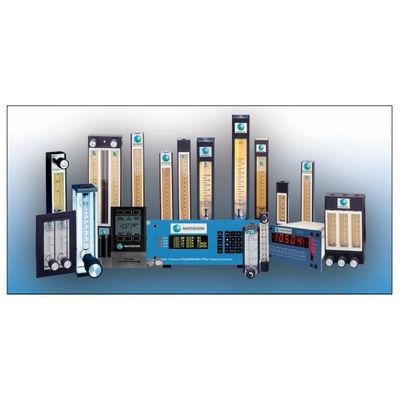
Matheson - Flow Measurement & Contro System
Flowmeters are used in fluid systems (liquid and gas) to indicate the rate of flow of the fluid. They can also control the rate of flow if they are equipped with a flow control valve. Rotameters are a particular kind of flowmeter, based on the variable area principle. They provide a simple, precise and economical means of indicating flow rates in fluid systems. This variable area principle consists of three basic elements: A uniformly tapered flow tube, a float, and a measurement scale. A control valve may be added if flow control is also desired.
In operation, the rotameter is positioned vertically in the fluid system with the smallest diameter end of the tapered flow tube at the bottom. This is the fluid inlet. The float, typically spherical, is located inside the flow tube, and is engineered so that its diameter is nearly identical to the flow tube’s inlet diameter.
When fluid — gas or liquid — is introduced into the tube, the float is lifted from its initial position at the inlet, allowing the fluid to pass between it and the tube wall. As the float rises, more and more fluid flows by the float because the tapered tube’s diameter is increasing. Ultimately, a point is reached where the flow area is large enough to allow the entire volume of the fluid to flow past the float. This flow area is called the annular passage. The float is now stationary at that level within the tube, as its weight is being supported by the fluid forces which caused it to rise. This position corresponds to a point on the tube’s measurement scale and provides an indication of the fluid’s flow rate
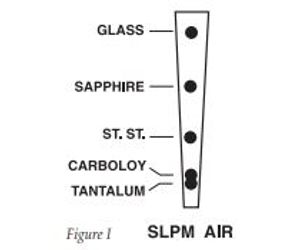
One way to change the capacity, or flow range, of a rotameter is to change the float material, and thus its density, while keeping the flow tube and float size constant. Floats which are made from less dense materials will rise higher in the tube and therefore will yield lower flow capacities for the same diameter flow tube. Floats made from more dense materials will rise less thereby yielding higher flow capacities.
Relative flow capacities for some common float materials are shown in Figure 1.
Another way to change the capacity is to change the diameter of the flow tube and the size of the float.
Selecting The Right Flowmeter Size
There are certain factors which affect the measurement of a fluid’s flow rate with a rotameter. The fluid’s temperature, pressure and specific gravity all impact gas flow measurements. Flow capacities (ranges) for the flowmeters described in this catalog are given for air at standard conditions —- 14.7 psia (101.3 KPa Abs) and 70°F (21°C). Sizing a meter for a gas other than air, or for your specific application pressure and/or temperature, requires that you first determine the equivalent flow capacity in air at standard conditions. Once determined, the flow capacity tables in this catalog can be applied directly. Reference Scale tables can be requested for each flowmeter ordered which will provide conversion to your desired fluid or conditions.
Note that for flowmeters calibrated at standard conditions with a valve on the inlet, readings on the tube are correct provided that the outlet pressure is close to atmospheric. When the valve is on the outlet, readings are correct if the inlet gas pressure is equal to the pressure for which the tube was calibrated.
For your convenience, Table 1 provides correction factors for gases other than air at standard conditions. Call a customer service representative if you require further assistance in sizing a rotameter for your particular application.