


- Home
- Companies
- JB Hyperspectral Devices GmbH
- Products
- JB Hyperspectral Devices - Model FloX ...
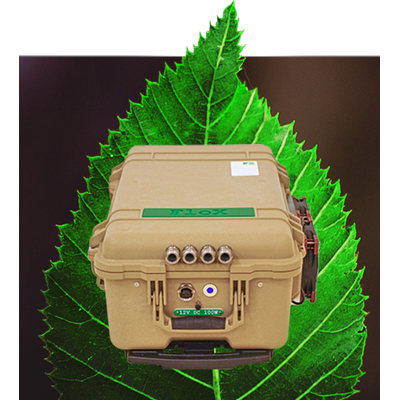
JB Hyperspectral Devices - Model FloX Chlorophyll -Fluorescence Observation System
The FloX system is an advanced instrument for monitoring chlorophyll fluorescence under natural light conditions. It is engineered to provide continuous, high-resolution spectral data, specifically focusing on the red and near-infrared regions (650-800 nm). The core technology is based on the QEPro spectrometer from Ocean Optics, enabling precise detection of chlorophyll fluorescence where atmospheric oxygen absorption bands are present. FloX is designed for sturdy, permanent outdoor installations. It features dual field-of-view channels for measuring solar irradiance and reflected radiance from canopies, while a robust housing with temperature control minimizes dark current interference. The system offers functionalities such as automatic signal optimization, real-time data streaming, and metadata integration, making it ideal for autonomous field use. It supports SDI-12 real-time data streaming and can handle varying light conditions efficiently, ensuring reliable data acquisition and analysis for research applications.The fluorescence box (FloX) is an unique instrument, enabling the continous observation of chlorophyll fluorescence. It measures spectral data of extremely high resolution, yet is built to withstand the hazards of a permanent outdoor installation.
The fluorescence box (FloX) is an unique instrument, enabling the continous observation of chlorophyll fluorescence. It measures spectral data of extremely high resolution, yet is built to withstand the hazards of a permanent outdoor installation.
It represents the evolution of prototypes such as the Multiplexer Radiometer Irradiometer (MRI), SFLUOR box and SIF-System developed from a collaboration between Jülich Research Center and the Remote Sensing of Environmental Dynamics Laboratory of the University Milano Bicocca. The basic routines of the FloX are based on SPECY (Forschungszentrum Jülich, IBG-2: Plant Sciences).
The FloX is specifically designed to passively measure chlorophyll fluorescence under natural light conditions. Therefore the design is optimized to achieve maximum efficiency in terms of: Signal to Noise Ratio, Spectral Resolution and quick acquisition time. The core of the system is the QEPro spectrometer from Ocean Optics covering the Red/Near Infrared region (650 – 800 nm). This is the spectral range where chlorophyll fluorescence is emitted and where the two atmospheric oxygen absorption bands (O2B and O2A, at 689 nm and 760 nm respectively) are used to measure it. Upward and downward channels of the FloX allow to measure the solar irradiance and the reflected radiance from the canopy. In order to keep a stable level of dark current the spectrometers are embedded in a temperature controlled housing. The signal-to-noise is maximized thanks to accurate automatic optimization of the signal of both channels and a high performance optical light throughput.
OPTIC Spec 1
Wavelength range: 650—800 nm
Spectral Sampling Interval (SSI): 0.17 nm
Spectral resolution (FWHM): 0.3 nm
Signal to Noise Ratio (SNR): 1000
Field Of View (FOV): Dual FOV. Upwelling radiance 25°. Downwelling radiance 180°
OPTIC Spec 2
Wavelength range: ~ 400–950 mn
Spectral Sampling Interval (SSI): ~ 0.65 nm
Spectral resolution (FWHM): ~ 1.5 nm
Field Of View (FOV): Dual FOV. Upwelling radiance 25°. Downwelling radiance 180°
OPERATIONAL
OPERATIONAL: Signal Optimization
Signal Optimization: Automatic adaption to varying light conditions
Dark current: Accurate dark current determination at each measurement cycle
Manual acquisition: Interface software for manual measurement and calibration
Automatic acquisition: Fully autonomous measurement mode for unattended data acquisition
Quick measurements: 20 seconds under bright sunshine 60 seconds in overcast condition
Stability: Reference system stability check and uncertainty estimates
Simultaneous metadata: Spectrometer temperature, Outside temperature, GPS position, GPS time
Data Display: Live assessment of the systems status
Data storage: SD card up to 32 GB (12 months of measurements)
Case: Robust and Waterproof housing based on the 1510 Pelicase
Dimension: Small form factor (50 × 30 × 20 cm)
Power supply: 12 Volt. From battery or solar panels
Power consumption: Average consumption of 60 Watt. (20/100 Watt, cooling on/off)
Energy saver: Day/night switch for energy saving
Interfaces: RS232 via cable and wireless
OPTIONAL
OPTIONAL: Dust Protection
Dust Protection: Additional dust protection for Cosine Receptors
Fiber optics: Flexible length of fiber optics according to user needs
Power supply: Solar panel and battery
Communication: Addon for LAN/WLAN/Mobile Network Remote access