


- Home
- Companies
- Endura Coatings
- Products
- Endura - Model Series 300 - ...
Endura - Model Series 300 -Fluoropolymer Coatings
A fluoropolymer is a polymer that contains molecules of carbon and fluorine. They are high-performance plastic materials used in harsh chemical and high-temperature environments, primarily where a critical performance spcification must be met. Fluoropolymer coating or "Teflon-like" coatings are engineered to create a wide array of performance benefits.
- Corrosion protection
- Dielectric Properties
- Lubrication
- Non-Stick
- Non-Wetting & Static Dissipation
- Squeak Suppression
Read more on our Fluoropolymer (Series 300) Performance Factors such as the hardenss equivalents from 55 to 80 Shore D.
Since 1970, our highly experienced teams of engineers and chemists at Endura have formulated an abundance of unique and proprietary technology solutions which offer a broad combination of performance advantages and surface characteristics above and beyond those of standard Teflon or "Telfon-like" finishes.
We regularly procure new material blends and invest in the latest material and application technologies for our fluoropolymer coatings. This commitment to continuous improvement ensures that we are on the forefront of innovation and meet or exceed our customers’ expectations of service and industry know-how.
Specific fluoropolymer coatings are FDA and NSF compliant, USDA approved, biocompatible per ISO 10993, and are used extensively in a variety of environments in which non-stick, insulating, and chemical or corrosive protective properties are paramount. We have a longstanding history of success in industries such as thermoforming, food and beverage processing and packaging, medical, pharmaceutical and diagnostics, and computer and business machinery components.
In addition to the many FDA / USDA / NSF approved coating systems we offer, Endura also provides services to the HVAC industry. We provide numerous custom engineered fluoropolymer coating systems specifically designed to withstand the aggressive service environments of industrial manufacturing plants, chlorinated pool facilities, coastal sea areas and medical facilities. Whether you are looking to mitigate corrosion to prolong the service life of your units, or increase their performance efficiencies; our proprietary, highly engineered coating systems can greatly increase the functional benefits of HVAC coils by reducing corrosion, friction, sticking, and wear.
If you are looking for assistance in fabrication, please contact Coil Replacement Company to provide custom and direct OEM heating and cooling solutions.
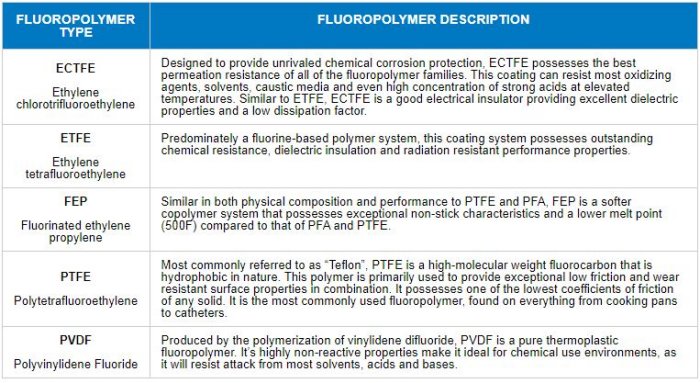
Along with our proprietary resin formulations, we offer and apply most of the major fluoropolymer families:
At Endura Coatings, we offer our Series 300 Fluoropolymer coatings that are engineered to provide lubrication, corrosion resistant and low friction surface properties. This can be applied to the majority of metal substrates including; steel, stainless steel, iron, brass, bronze, copper, hastelloy, inconel, monel, nickel alloys and aluminum
Step 1: Temperature controlled contaimination removal from top surface and sub-surface area
Step 2: Proprietary equipment ensures removal of all contamination to optimize adhesion without altering part`s dimensional integrity
Step 3: Fluoropolymer coating applied via spray, robotic arm, fluidized bed and dip spin methods.
Step 4: Multi-step bonding and polymer curling process to create stratified matrix designed to satisfy specific performance objectives
Step 5: Fluoropolymer infusion occurs as the final step
Read more on our Fluoropolymer Coating specifications and performance factors.
Suitable Coating Materials
Series 300 fluoropolymer coatings can be successfully applied to most all metal substrates including but not limited to: steel, stainless steel, iron, brass, bronze, copper, hastelloy, inconel, monel, nickel alloys, and aluminum. Endura® can also apply select 300 Series coatings to glass substrates.
Coating Thickness
Coating thicknesses within our 300 Series platform vary by application. Our 300 Series coatings are typically applied nominally 0.001 inch to 0.0025 inch per surface, however; some applications can be applied as thin as 0.0003 inch or as thick as 0.030 inch per surface.
Wear & Abrasion Resistance
Our 300 Series coatings have comparatively softer finishes when weighed against our other coating platforms. This notwithstanding, certain applications within our 300 Series product family possesses thicker film deposits and exhibit good wear resistance. For instance our Endura® 300ECS coating exhibits excellent abrasion and impact wear resistance. This coating possesses superior bond strength and will not erode or dis-bond from your base metal substrate. Depending on the nature of wear, in your use environment, there may be a number of 300 Series solutions that meet your application`s durability needs.
Chemical & Corrosion Resistance
Endura®`s Series 300 product platform contains an array of chemically inert coating systems that exhibit excellent corrosion resistance, some of which possess pin-hole surfaces that afford unrivaled permeation resistivity. Depending on the corrosive elements of your use environment certain 300 Series coatings may be better suited than others to meet your performance objectives. To ensure we specify the most appropriate 300 Series solution for your use environment, MSDS sheets may be requested by our technical consultants for review. Once a spec has been determined, we recommend that you evaluate the selected Endura® 300 Series coating against the corrosive elements of your application. Sample coupons are available upon request to test the compatibility of our coatings in your use environment.
Non-Stick (Release) Properties
Series 300 coatings afford the highest attainable release of any of our product platforms. Whether you require non-stick from tactile plastics such as polypropylenes or an FDA/USDA compliant high release coating for a food processing application, our Series 300 coatings afford non-stick surface characteristics that are truly unique. Many of these coatings provide contaminant free surfaces, allowing for easier cleaning and maintenance.
Operating Temperature Range
Coatings will withstand severe temperature extremes without loss of physical properties, and are designed for operation in environments from cryogenic temperatures to 500°F (with intermittent exposure to 550°F).
Electrical Properties
Depending on your application objectives, Endura® 300 Series coatings can be engineered to provide high dielectric strength as well as excellent electrical conductivity. We possess coatings that afford both strong electrical insulating properties as well as coatings that are highly conductive. For instance, our Endura® 375 exhibits dielectric strength of 5,600 volts/mil of coating thickness, while our Endura® 366 was recently used on a glass application and provided 11k ohms at 0.8mil dry-film thickness.
Non-Wetting
Many of our 300 Series coatings exhibit excellent non-wetting surface characteristics and are both oleophobic and hydrophobic in nature. Depending on the requirements of your application, a variety of 300 Series products may meet or exceed your performance objectives.
Critical Processing Factors for Series 300 CoatingsHow Coatings Are Applied
Our Series 300 coatings may be applied in a variety of ways and is contingent on the specific coating/material system we are depositing. Application methods may include but are not limited to: dipping, conventional spray, electrostatic deposition (liquid & powder), and fluidized bed. In all applications, final sintering is accomplished in microprocessor-controlled ovens with curing temperatures typically ranging from 250°F to a maximum of 800°F.
Masking
Masking of select surfaces where coating voids are required is available. Endura® works with a variety of mediums to mask surfaces where coating is not desired. Depending on your part`s geometry and surface characteristics painted-on lacquers, pull-plugs, and custom fabricated fixtures may be used to accomplish the aforesaid. In the event masking is required, highlighted or “marked” prints identifying critical surfaces are extremely helpful in ensuring your parts are processed to spec.
- Typical Surface Growth 0.0001"
- Hardness Equivalent - 55 Shore D
- Non-Stick - Very Good
- Lubrication - Good
- Non-Wetting - Good
- Corrosion / Chemical Resistance - Good
- Taber Abrasion Resistance - 0.01 g
- Friction (Dynamic/Static ASTM 1894) - 0.10/0.12
- Salt Spray Resistance (ASTM B117) - 500+h
- Dielectric Strength - N/A
- Max. Continuous Operating Temperature - 500 °F
- FDA/USDA - Compliant