- Home
- Companies
- Wastewater Level LLC
- Products
- FOGRod - Wastewater Level Sensor

FOGRod - Wastewater Level Sensor
The ideal wastewater level sensor will never run your pumps dry. The ideal lift station level control system will always start the pumps no matter how much grease is in the wetwell. That`s why you need the FOGRod. It works so well because it is simple - almost as simple as floats, but with much less maintenance; way simpler than ultrasonics; and can`t fail like pressure transducers.
- 10% of the maintenance of floats
- Can`t fail like pressure transducers – 10 year warranty
- 10x easier than ultrasonics
- Replaces floats or analog level devices with no wiring changes
- No moving parts, sensors or electronics in the wetwell
- Can`t run the pumps dry
- Failsafe
- Alarms when it needs cleaning
- Easy to clean - pull it through the cleaning pad
- Simple and quick to install
- No rewiring of your control system
- No configuration or calibration
- As easy to understand as floats
- Class I Division 2 with no barrier, Division 1 with barrier (and ATEX zone 0)
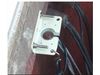
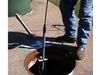
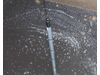
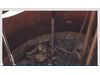
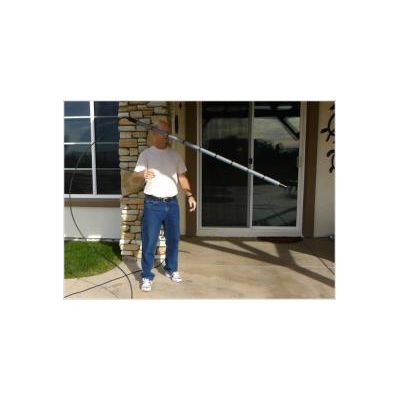
Does it work when it covered in grease? The lift station photo on the left shows a FOGRod still working fine two months after the last clean. The installation photo on the right makes it easier to see where the FOGRod was installed in the lift station:
We see from this photo that you can`t tell by looking whether the grease will cause a problem. Sometimes a lot less grease than this will cause measurement problems. The LIT detects when level measurement is affected by grease, works around it, and gives you alarms to indicate that cleaning is necessary.
How is the FOGRod installed and how do you clean it? This lift station level device hangs from its own cable, and from the mounting bracket that is supplied with the FOGRod. The mounting bracket is bolted into the concrete or steel just under the lid.
This is much easier than cleaning floats.
The mounting bracket includes a cleaning pad – just pull the FOGRod through it to clean it off.
To learn more, read Why Try the FOGRod, take a look at more installation photos to see how simple it is. Or watch the video, which explains how the whole system works in 6 minutes - with some more detailed explanation following that introduction:
The FOGRod hangs in the wastewater and connects to the LIT in the control panel with its 11-core cable. The LIT applies a small voltage to each metal contact on the FOGRod and looks for current flow. When a FOGRod contact is under water, current flows to ground. When a contact is dry, no current flows. It’s like closing a lightswitch – but in this case wastewater completes the circuit.
The LIT has 10 relays corresponding to the 10 contacts on the FOGRod. Pick the relays you want to use and wire them into your PLC, your pump controller – or even directly into your starters. If you are replacing floats, just unhook the float wires and connect the LIT relays into the same points.
It’s like having 10 floats, but you just pick the ones you want to use.
The LIT also has a 4-20mA output that increases in 1mA steps for each FOGRod contact. So you can replace pressure transducers, ultrasonics and bubblers. If you are replacing floats you can wire the 4-20mA into your telemetry system and get remote level.
Failsafe in the Worst Grease
The FOGRod has no moving parts, no electronics and no sensors – so there’s nothing in the wetwell to tangle up, get stuck in position, or fail.
But what about grease buildup? Grease does build up, especially around the lead pump start. Hang the FOGRod in the turbulentpart of the well near the inflow. The grease is all broken up and when it builds up on the FOGRod it doesn’t completely isolate the metal
contacts from the wastewater.
Suppose the grease buildup gets so bad that it completely isolates the lead pump contact from the wastewater – the lead pump won’t start. The level keeps rising, but when it gets to the contact above (which is cleaner) the LIT registers that level.
The LIT now activatesallthe level relays up to this point – so the lead pump starts, just a little later. And the LIT knows there is a problem because there is a “dry” contact below a “wet” contact so it activates a fault relay and a fault light comes on. The fault relay can be wired into telemetry.
That warning tells you it needs cleaning – it’s not usually an urgent alarm, but you know when the grease buildup is starting to affect the device. The FOGRod is easy to clean. Just pull it up by the cable through the tough “squeegee”, the cleaning pad that is held in the mounting bracket.
Compare that with cleaning floats. Transducer “cleaning” often results in an (expensive) return to factory.
The whole solution – the LIT which goes in the control panel, the FOGRod which hangs in the well with 50ft cable, the mounting bracket & cleaning pad – costs $980 delivered to your door.
With 100ft cable, the delivered price is $1,080.
Ragging and Normal Grease Buildup
What about rags? This is a major issue (usually) for conductive level devices. The FOGRod/LIT has some patented technology to deal with rags and buildup.
First, the metal contacts are not one above the other, they are offset by 120 degrees. This makes it much less likely to short two contacts with rags. More important – the LIT checks for two different contacts being activated too quickly. When this is detected, the LIT starts a 3-minute timer and holds out all of the higher level relays from activating until the end of the timer period. This prevents short cycling. At the end of the 3 minutes the Clean FOGRodalarm latches on the LIT, giving a visual alarm and activating a fault relay. You can wire this into telemetry so you will know there is a problem.
Normal grease buildup eventually can have the same effect of “shorting out” adjacent contacts, starting the lead pump earlier. The fault monitoring described above will prevent short cycling in the same way.
Cable Breaks
The FOGRod cable has 11 cores but only 10 contacts. One of the cores is a “loopback” test for the top contact. If the cable is broken (e.g., from rats eating the cable) the LIT will register an alarm and activate a fault relay. The same happens if the cable insulation is stripped off in the cable conduit.
Ease of Installation & Warranty
The FOGRod has a 10-year warranty. The LIT has a 2-year warranty – extendable to 5-years for another $100.
You can replace your floats or your transducer (or ultrasonic or bubbler) without any changes to your control logic or PLC – no rewiring or reprogramming needed. It’s a very simple install.
Ask for a demo, or request a free 35-day trial. See for yourself why the FOGRod is so popular with collection system guys.
How tough is the FOGRod?
In the five minute video below, you see the FOGRod being thrown up into the air, landing on concrete…
That’s one reason why there’s a 10 year warranty on the FOGRod. Another reason is the AL6XN stainless steel used for the FOGRod contacts, much higher grade than 316.
How bright are the LEDs in the Level Indicator Transmitter (LIT)?
In the video above, the LIT is shown in the bright Californian sun. Here is a frame from the video of the LIT when the level is at 90%:
FOGRod – The FOGRod ideally hangs in the turbulent part of the wetwell where the grease is broken up – but not directly under the inflow. Turbulence keeps the FOGRod relatively clean. Screw the mounting bracket into the wetwell wall just below the cover and hang the FOGRod from the S-hook.
Level Indicator Transmitter – The LIT (Level Indicator Transmitter) clips onto DIN rail in the panel. The FOGRod cable is wired into the color coded terminals.
The simplest approach – disconnect the float wires and connect the LIT relays into those same connections. This means that you won’t have to change anything at all in your PLC or control system. So if you currently have four floats wired into lead start, lag start, stop and high level you can simply wire the relevant LIT relay outputs into the same electrical connections in your control panel.
Nothing more to do!
And if you are replacing an ultrasonic, pressure transducer or bubbler, just connect the LIT’s 4-20mA into where the existing level device was wired.
How to Replace Your Floats with the FOGRod
Here is an example of a float replacement in Missouri. Four floats were already wired into a termination strip:
The mounting bracket/cleaning pad was fixed to the wall of the wetwell:
but because of the geometry of the wetwell we hung the 7.5ft FOGRod from a hook under the metal plate (to the left of the drill in the above photo). The bracket & cleaning pad is for when the FOGRod needs to be cleaned – we just pull it up through the cleaning pad/wiper. The FOGRod cable was pulled through conduit into the control panel.
Two holes were drilled in the inner door and DIN rail attached. Then the LIT was clipped onto the DIN rail. The annotation explains the wiring:
Relay 1 – wired into OFF – corresponds to the bottom contact on the FOGRod. Relay 4 – wired into Lead Start – corresponds to contact 4 on the FOGRod. The contacts on the 7.5ft FOGRod are 9 inches apart, so the separation between OFF and Lead Start is 27 inches (3×9).
Moving the lead start up by 9 inches is easily done – we would just move the wires from relay 4 to relay 5. Relay 6 corresponds to contact 6, so Lag Start is currently 18 inches above Lead Start.
The LIT runs off 12v or 24v dc, which was not available in this panel so we added a power supply:
A float replacement in Florida. The Level Indicator Transmitter in the control panel. Contact 1 is used for OFF, contact 5 is Lead Start, contact 6 is Lag Start and contact 9 is Alarm. And note the important ground connection (green wire) – this completes the measuring circuit to detect level:
Another site in the same network with the analog output (bottom left) connected to SCADA for remote monitoring of level. Later all of the sites were converted to FOGRods and all were connected up to SCADA for remote level:
The wetwell – the Fogrod cleaning bracket is in the bottom right corner of the photo, with the Fogrod hanging under the bracket in the bottom of the wetwell. This lift station level sensor can’t easily be seen, but it is hanging in the more turbulent part of the wetwell:
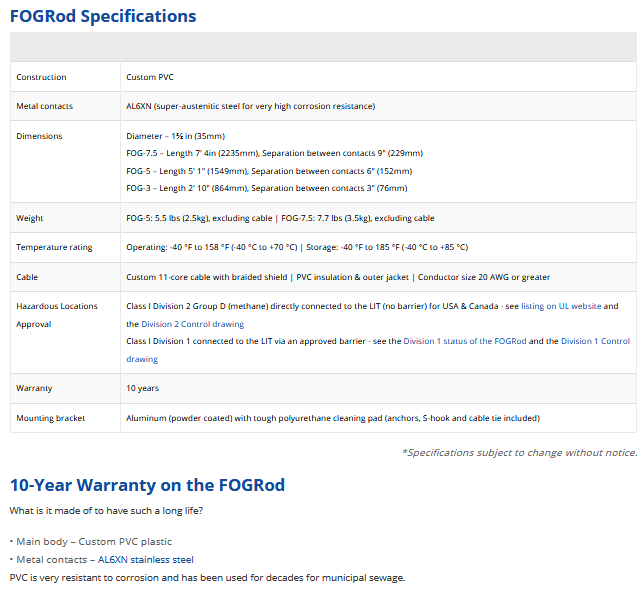
The FOGRod comes in three lengths – 7.5 ft, 5ft and 3ft – each type has 10 contacts (separated by 9″, 6″ and 3″ respectively). If you need a 10ft or 15ft Fogrod we supply 2x 5ft or 2x 7.5ft FOGRods (and 1 LIT). Each FOGRod has the option of two cable lengths – 50 ft or 100 ft and we manufacture custom units with longer cables to order. The FOGRod also comes with a 10-year warranty.
- PSU-12-NB 12v DC power supply, no battery backup. Dimensions: 0.9" x 3.5" x 3.9" (WxHxD)
- PSU-24-NB 24v DC power supply, no battery backup. Dimensions: 0.9" x 3.5" x 3.9" (WxHxD)
- FOG-ISB For Intrinsic Safety (Class I, Division 1): 6x 2-channel IS barriers - 9002/77-220-146-001 by R Stahl (qty 6)
- LIT-EW5 Extend LIT-100 warranty to 5 years
LIT Specifications
- Environmental
- Power supply 10v-30v d.c., 4W
- Temperature rating Operating: -40 °F to 158 °F (-40 °C to +70 °C) | Storage: -40 °F to 185 °F (-40 °C to +85 °C)
- Dimensions 7" (W) x 4" (H) x 1.5" (D) (178mm x 102mm x 38mm)
- Enclosure type High impact ABS with DIN rail clip
- Approval UL | C-UL (CSA) - see listing on UL website | CE approval (Europe) | RCM (Australia)
- Warranty Two years, extendable to five years (order part number LIT-EW5)
I/O and Indication
- Analog Output – Level 4-20mA output, 4mA = zero level, 5mA = 10%, 6mA = 20%, etc. to 14mA = 100% | Maximum load depends on supply voltage
- Accuracy better than 1%
- FOGRod I/O 11 FOGRod I/O - 8 VAC, low frequency: 10 level, 1 cable integrity (plus cable shield)
- LEDs – Fault & Power 1 green LED for power | 4 red LEDs for faults — Cable Open Circuit; Cable Short Circuit; Wiring or Contact Fault; Clean FOGRod
- LEDs – Level 10 green LEDs
- Relay Outputs - Faults 2 relays, rated at 250VAC / 30VDC 6A (resistive load), configurable as normally open or normally closed (N/O or N/C) - 1 relay for cable open circuit or short circuit | - 1 relay for contact dry below wet or FOG (fats, oils, grease) buildup
- Relay Outputs – Level 10 relays, rated at 250VAC / 30VDC 6A (resistive load), configurable as normally open or normally closed (N/O or N/C)
- Terminals All terminals standard screw type
Setting
- Conductivity Default conductivity threshold = 50kΩ, range from 3k – 300kΩ
- DIP switches
- Level relays – Normally Open / Normally Closed
- Fault relays - Normally Open / Normally Closed
- Level relays and LEDs – 1 sec / 10 sec activation
- 4. Clean FOGRod alert - On/Off