

- Home
- Companies
- Josef Meissner GmbH & Co. KG
- Products
- Josef Meissner - Formaldehyde Plants
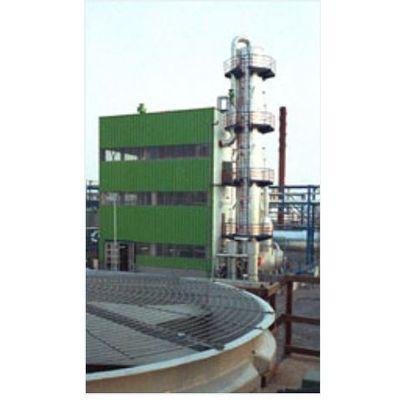
Josef Meissner - Formaldehyde Plants
Formaldehyde is one of the most important raw materials in industrial chemistry and is predominantly used in the manufacture of glues and resins. Formaldehyde is usually traded in the form of an aqueous solution with a concentration of about 37%. Formaldehyde is mainly produced by catalytic conversion of gaseous Methanol, either over a Silver Catalyst or a Metal Oxide Catalyst.
MEISSNER offers both processes as well as a series of process variants. The most suitable process is individually chosen according to customer-specific requirements, such as product qualities to be met or prevailing infrastructural conditions.
With the classic MEISSNER variant of the Silver Catalyst process, pure Methanol is fed to the catalyst. Together with the unconverted Methanol, the generated Formaldehyde is washed out of the gaseous phase in an absorption unit by means of water. In order to adjust the Methanol content to the desired value, the obtained raw solution is subjected to a distillation step, and the separated Methanol is returned into the process. Formaldehyde solutions of about 50-55% concentration with less than 1% of residual Methanol can be produced with this process.
In another MEISSNER process variant, Methanol is fed to the Silver Catalyst together with water. The admixture of water enables an enhanced conversion of Methanol. Therefore, the Formaldehyde solution of about 40-44% concentration obtained in the absorption unit only contains 3-5% of residual Methanol without any distillation step - favourable in terms of both capital investment and operating costs.
For the MEISSNER Metal Oxide Catalyst process, a Methanol lean mixture is fed to the catalyst. As this allows an almost complete conversion of the Methanol, Formaldehyde solutions of about 50-55% concentration with a content of less than 1% of residual Methanol can be produced without any distillation. Besides very favourable consumption figures for Methanol, this process offers the further advantage that the reaction heat is utilized for the generation of steam, which is then available for external consumers. A process variant works with tail gas recycling, which allows a capacity increase with unaltered dimensions of the main plant components.