


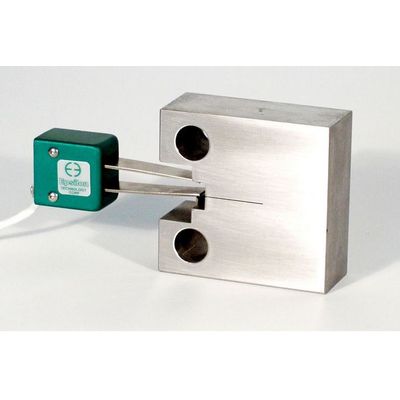
Epsilon - Model 3541 -Fracture Mechanics Clip-On Gages
For fracture mechanics studies, these COD gages are in compliance with standardized test methods, such as ASTM E1820 for determination of fracture toughness properties of metallic materials.
The Model 3541 is designed for determination of fracture mechanics parameters such as JIC, KIC, R-curve, fatigue crack growth rate (da/dN), and testing to standards such as E1820, E399, E647, etc. These COD gages conform to the requirements of E1820 (the replacement for E813 and E1737) for JIC and R-curve determination. Special configurations are available to meet the requirements of ASTM E399 for fracture toughness (please consult the factory for these configurations). In addition, the modified groove design complies with E1820 tests where greater stability and accuracy results from the sharper groove root. Clip-on gages are used for a variety of fracture mechanics tests, including compact tension, arc shaped, disk shaped, bend specimens or other specimen geometries in compliance with ASTM and other standards organization’s test methods. Clip-on gages can be used directly on test specimens where the knife edges are integral with the test specimen or, alternately, with optional bolt-on knife edges mounted on the test specimen.
Model 3541 crack opening displacement gages are strain gaged devices, making them compatible with any electronics designed for strain gaged transducers. Most often they are connected to a test machine controller. The signal conditioning electronics for the extensometer is typically included with the test machine controller or may often be added. In this case the extensometer is shipped with the proper connector and wiring to plug directly into the electronics. For systems lacking the required electronics, Epsilon can provide a variety of solutions, allowing the extensometer output to be connected to data acquisition boards, chart recorders or other equipment.
- May be left on through specimen failure.
- Full bridge, 350 ohm strain gaged design for compatibility with nearly any test system.
- Fully enclosed gages are protected from accidental damage.
- Sharp grooves per ASTM E1820 and E399 for improved stability when mounted.
- Maximum operating frequency may be from 5 Hz to >200 Hz depending on COD gage and test apparatus configurations.
- For da/dN testing or pre-cracking, where maximum frequency (>50 Hz) is required, minimum measuring ranges are recommended.
- For KIC/JIC testing, maximum accuracy is achieved with the smallest measuring range and the largest gauge length that will perform the test.
- Includes the Epsilon Shunt Calibration System for on-site electrical calibration.
- Includes high quality foam lined case.
- Excitation: 5 to 10 VDC recommended, 12 VDC or VAC max.
- Output: 2 to 4 mV/V, nominal, depending on model
- Accuracy: All standard units meet ASTM E1820, ISO 12135, and ISO 9513 Class 1 requirements for accuracy. A test certificate is included. Models that additionally meet ASTM E399 accuracy requirements are available in 2.5 and 4.0 mm (0.10 and 0.15 inch) measuring ranges. A test certificate for ASTM E399 is included with those models.
- Linearity: ≤0.2% of full scale measuring range
- Temperature Range: Standard (-ST) is -40 °C to +100 °C (-40 °F to +210°F)
- Cable: Integral, ultra-flexible cable, 2.5 m (8 ft) standard
- Operating Force: 9 to 14 N (2 to 3 lbs), depending on model
- Connectors to interface to nearly any brand of test equipment
- Available in special versions, including setups for narrow grips or severe environments
- Bolt on knife edges