


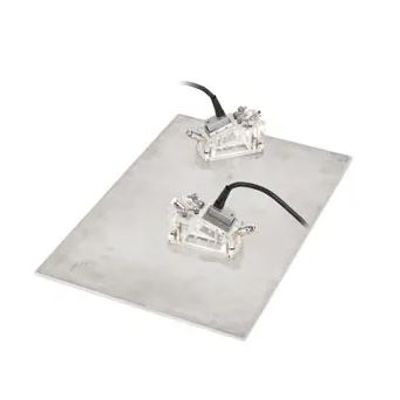
Evident - Model FSW -Friction Stir Weld Inspection System
Friction-stir welding (FSW) is a process mostly used on aluminum parts for high grade applications, notably in the Aerospace and Defense industry. Instead of using added material as is done for conventional welding methods, a tack tool is used to heat and mix the two pieces of metal in the jointed area. FSW has multiple advantages over traditional welding methods; FSW avoids the defect types that tend to arise with liquid phase cooling in other welding methods. Additional defect types occur mostly as a result of insufficient temperatures or welding conditions; these defects must be correctly identified and sized.
Natural Defects
Different types of defects can occur in friction-stirred welds, such as incomplete continuity of the bond between the material from each side of the weld (referred to as “kissing-bond”), long tunnel-like defects, and lack-of-penetration. Also, due to the friction-stir welding process, defects can be randomly oriented inside the weld.
Calibration Defects
Longitudinal, transverse, and oblique notches located on the OD and ID are used as references for the calibration process. Side-drilled holes are also employed to build the time-corrected gain (TCG) curve, which will account for signal attenuation inside the material.