


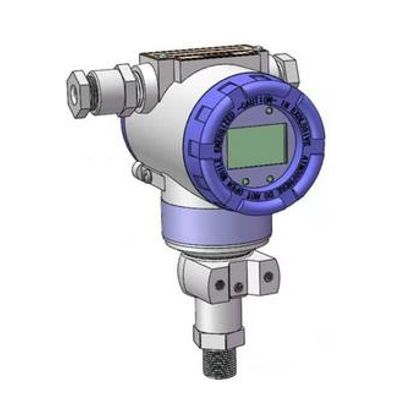
Sino-Inst - Model SMT3151 TGP -Gauge Pressure Transmitter/Transducer
Gauge Pressure Transmitter / transducer (GP) is a pressure transmitter for Gauge pressure measurement. Gauge pressure transmitter can measure the pressure of liquid, gas or steam. And convert it into 4 ~ 20mA DC signal output. The GP pressure transmitter can communicate with the HART Communicator, through which it can be set and monitored. Gauge pressure refers to pipeline pressure. “Gauge pressure” starts from atmospheric. Gauge Pressure plus atmospheric is the absolute pressure.
Common Industrial Applications of Gauge Pressure Transmitter
- Mechanical and plant engineering
- Chemical industry
- Medical technology
- Food and beverage
- Oil and gas industry
- Packaging and paper industry
- Pharmaceutical industry
What is a Gauge Pressure Transmitter?
Gauge Pressure Transmitter is one of the common industrial process pressure transmitters. Mainly used to measure the pressure of liquid, gas and other gauges. HS code: 9026201090.
A gauge pressure (GP) transmitter compares the process pressure with the local ambient air pressure. The gauge pressure transmitter has a port for real-time sampling of ambient air pressure.
High-precision gauge pressure transmitters may be affected by local environmental pressure fluctuations. Measurements above ambient pressure are expressed as positive numbers. A negative number indicates a measured value below ambient pressure.
The gauge pressure measurement value is indicated by the letter “g” after the unit of measurement (ie, inH 2 O (g) or psig).
Gauge pressure transmitter working principle
SMT3151 TGP-Gauge Pressure Transmitter / Transducer is a diffusion silicon pressure transmitter. The working principle of the diffused silicon pressure sensor is based on the piezoresistive effect. Using the principle of piezoresistive effect, the pressure of the measured medium directly acts on the diaphragm of the sensor (stainless steel or ceramic). Make the diaphragm produce a slight displacement proportional to the pressure of the medium. To change the resistance value of the sensor. Use electronic circuits to detect this change. And convert and output a standard measurement signal corresponding to this pressure.
Absolute pressure
Absolute pressure is referred to as the vacuum of free space (zero pressure). In practice, absolute piezoresistive pressure sensors, measure the pressure relative to a high vacuum reference, sealed behind its sensing diaphragm. The vacuum has to be negligible compared to the pressure to be measured. Sino-Instrument’s absolute pressure sensors, offer ranges from 1 bar or even 700 mbar as well as barometric pressure ranges.
Gage pressure
Gage pressure is measured relative to the ambient atmospheric. The average atmospheric at sea level is 1013.25 mbar. Changes of the atmospheric, due to weather conditions, or altitude influences the output of a gauge pressure sensor.
A gauge pressure higher than ambient pressure is referred to as positive pressure. If the measured pressure is below atmospheric, it is called negative or vacuum gage pressure. In general, a vacuum is a volume of space that is essentially empty of matter.
According to its quality vacuum is divided into different ranges such as an e.g. low, high and ultra high vacuum.
Differential pressure
Differential pressure is the difference between any two process pressures p1 and p2. Differential pressure sensors must offer two separate pressure ports, with a tube or thread. Sino-Instrument’s amplified pressure sensors, are able to measure positive and negative pressure differences. i.e. p1>p2 and p1<p2.
These sensors are called bidirectional differential pressure sensors, with ranges of e.g. -1…+1.0 bar or -2.5…+2.5 mbar. In contrast, unidirectional differential pressure sensor only operate in the positive range (p1>p2). E.g. from 0…1.0 bar or 0…2.5 mbar. And the higher has to be applied to the pressure port defined as “high pressure”.
Gauge Pressure VS Absolute Pressure
- Gage pressure refers to pipeline pressure. It refers to the pressure measured with pressure gauges, vacuum gauges, U-shaped tubes and other instruments, also called relative pressure). “Gage pressure” starts from atmospheric pressure.
- The pressure directly acting on the surface of the container or object is called “absolute pressure”. The absolute pressure value starts with absolute vacuum.
Absolute pressure actually refers to the gauge pressure plus the local atmospheric pressure (generally a standard atmospheric pressure can be 101.3Kpa).
Absolute pressure = gauge pressure + one atmosphere
If the unit is MPa, absolute pressure = gauge pressure + 0.1MPa
- Nominal pressure: from 0 … 400 mbar up to 0 … 600 bar
- Output signals : 2-wire: 4 … 20 mA ; others on request
- Special Characteristics:
- turn-down 1:10
- two chamber aluminum die-cast case or stainless field housing
- internal or flush welded diaphragm
- HART®-communication
- IS-version: Ex ia = intrinsically safe for gases and dusts
- accuracy: 0,1 % FSO
- Optional versions
- IS-version: Ex d = flameproof enclosure
- SIL2 – version according to IEC 61508 / IEC 61511
- integrated display and operating module
- special materials as Hastelloy® and Tantalum
- cooling element for media temperatures up to 300 °C
- Output signal: 4-20mAdc. Output, superimposed HART protocol digital signal (two-wire system)
- Power source: External power supply 24V dc. Power supply range 12V ~ 45V
- Installation in dangerous places Flameproof ExdIIBT5Gb; (explosion-proof certificate no. :CE16.1163) Intrinsically safe ExiaIICT4/T5/T6Ga; (explosion-proof certificate no. : CE15.2354X)
- Accuracy: ±0.1%, ±0.075%
- Stability: ±0.2%/12 months of the maximum
- range
- Temperature effect: Including zero and range
- for maximum temperature error of ±0.2% / 20 ℃
- Power supply impact: Less than 0.005% / V of
- the output range.
- Vibration effect: In any axial direction, the
- frequency is 200Hz, and the error is ±0.05% /
- g of the maximum range.
- Electronic circuit board work in: – 40 ~ 85 ℃;
- Sensitive components work in : – 40 ~ 85 ℃;
- Storage temperature : – 40 ~ 85 ℃;
- With digital display: – 25 ~ 75 ℃ (run);
- – 40 ~ 85 ℃ (no damage);
- Relative humidity: 0 ~ 95%
- Overpressure limit: 2~5 times the maximum
- range of pressure transmitter is not damaged.
- Volume change: Less than 0.16cm3
- Damping: The time constant is adjustable from
- 0.1 to 32.0s.
- Startup time: 3s, no preheating required.