


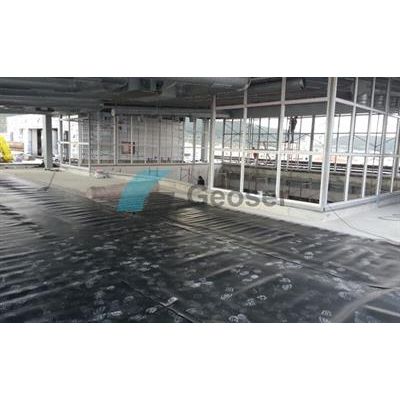
Geoser - Geomembranes
If geosynthetic clay and similar artificial impermeable materials are used in the storage base of the regular storage facility, it is also obligatory to provide a thickness of 50 cm. Article 16 of the existing Regulation 2. The soil impermeability layer is strengthened by Geomembrane (geomembrane) in Class I and Class II sanitary landfill facilities which provide the minimum permeability and thickness properties naturally.
Geomembrane (Geomembrane) Usage Areas
Geomembranes are mainly used to provide complete impermeability. Full impermeability in field applications is again provided by geomembranes.
Geomembrane (Geomembrane) Properties;
- Resistant to chemical substances.
- Low permeability.
- High resistance to puncture and cracking.
- Long life.
- The application is fast and economical.
- Repairs are easy.
The use of geomembranes in the environment, hydraulics and transportation is as follows;
- Hydroelectric Power Plants Water Conduction Channels
- Water collecting pools of ponds
- Impervious Floor Construction of Solid, Medical and Hazardous Waste Areas
- Designing the Case Area in Mining Activities
- Oil Field Tanks` Soil Impermeability
What are Geomembrane Usage Areas?
- Solid Waste Landfills
- Ponds (Artificial lakes)
- Medical Waste Collection Areas
- Treatment and Irrigation Pools
- Channels and Canals
- Toxic Waste Areas
- Tanks
- Wastewater Pipes and Tunnel Insulations
- Dams and Water Ponds
- Fish and Marine Seed Production Pools
- Buildings
- Plant Treatment Facilities
- Underpass on
- It is applied for insulation and surface protection in areas such as subway works.
Geomembrane rollers must be packaged and loaded properly to avoid damage. Geomembrane should be stored in a way that it is protected from drilling, from kernels, oil, water, moisture, mud, mechanical wear, extreme temperatures and other damages.
2.1 General
Before Geomembrane application, at least 15 cm depth of the open floor should be compressed by 95%. The parts that are not tightened enough, the weak or the collapsed parts are removed and the place is filled in properly. All surfaces to be covered should be flat, free from foreign and organic materials, cuttings and debris. Water deposits and excessive moisture should not be allowed.
2.2. Anchor Hinge
The anchoring ditches should be excavated as shown in the application projects before the geomembrane is laid. The trench corners should be rounded slightly to avoid sharp twists at the junction of the geomembrane with the ditch.
3) Placement Method
No equipment shall be harmful to the geomembrane by any other means during transportation, handling and use.
No staff is allowed to smoke while working on a geomembrane, should not wear shoes that will damage geomembrane, and should not be able to find any other activities.
The method used to open the panels should not cause geomembrane scratches or creases, nor damage the geomembrane or the geotextiles laid underneath.
Adequate weights (such as sandbags or similar weight materials, not to damage the geomembrane) should be placed to prevent the wind from being lifted. (In the case of strong winds, the risk of getting under the panes of the wind is reduced by placing a constant weight along the edges of the panel).
Direct contact with the geomembrane should be minimized. As an example, the compulsory areas to be roamed on the geomembrane should be protected with geotextile, additional membrane or other suitable materials.
Weather Conditions: Geomembrane placement should be performed provided the ambient temperature is between 0 ° C and 40 ° C. Welding should not be done during rain and during the early morning rain.
The approved welding method is an automatic fusion welding or extrusion welding. Sources should be arranged as parallel as possible. Avoid straight-up welds, corner and geometric-shaped parts, the field resources should be reduced the most. The T sources in the front should not be closer than 1.5 meters to the slope. The welds should be arranged at least to form a wrinkle and a "fishmouth".
4.1 Welding Seam
Geomembrane panels should be placed with a minimum 10 cm overlap for fusion welding and 7.5 cm minimum for extrusion welding.
4.2 Welding Equipment and Accessories
The equipment approved for field welding is fusion (hot shoe) and extrusion welding machines and the following equipment must be available.
1. Fusion (Hot Shoe) Welding Machine
2. Extrusion Welding Machine
3. High-speed grinder (Grinding tool)
4. Hot Air Blower
5. Vacuum Test Equipment
6. Field tensiometer and test specimen cutting equipment for weld shear and peel tests
7. Equipment for air pressure testing
8. Roll opening equipment
9. Required Electrical Wires and other equipment
4.3 Test Resources
Field test resources should be established to verify the suitability of welding conditions and welding equipment. Test sources should be repeated for all welding equipment used at the beginning of each welding period and for significant air changes. All test resources must be in the area to be welded. Test source length; it should be 2 meters for fusion welding, 1 meter for extrusion welding. 1-inch wide test specimens shall be cut from the test specimen and these test specimens shall be tested using a tensiometer for slip and peel tests.
The weld slip test samples shall be 1 inch wide and the gripping range shall be 4 in. Plus weld width. Must be located exactly between the source concepts, Coupling separation speed should be 2 inches per minute.
Both the weld slip test and the peel tests should be carried out on a similar specimen. At least four of the five samples must be successful in the test. For both sources, the fracture originating from the weld is characterized as Non-FTB (not applicable). Approved welding methods are fusion (hot shoe) and extrusion sources.
4.4.Saha Resources Tests
All testing equipment and equipment must be available at all times and must be available at all times.
4.4.1. Vacuum Test
Vacuum test or spark test is applied to test single welded fusion sources and extrusion welds. Vacuum test equipment consists of:
1. A vacuum box consisting of a solid cabinet, a transparent viewing window, a soft rubber seal mounted on the underside and a vacuum motor.
2. A plastic bucket and a large size brush.
3. A foamy solution.
For the test, the practitioner will perform the following.
1. The redundant parts of the building will be cut off.
2. Vacuum box viewing window, gasket surfaces to be cleaned, places that may be fugitives will be checked.
3. Immerse the foamed solution into a strip of about 30 cm x 120 cm (box size) over the geomembrane.
4. Place the box on the wetted area and press down.
5. The vacuum motor is started and the vacuum box is supplied with the geomembrane.
6. Check that there are no fugitives.
7. Investigate the presence of bubbles in the soapy solution through the monitoring window for approximately 15 seconds and examine the geomembrane.
8. If no bubbles appear for 15 seconds, the vacuum motor is turned off and the membrane is released. The box is overflowed with the 15 cm test piece and the adjacent part is brought back and the process is repeated.
9. All bubbling areas should be marked, repaired and retested.
Spark Test
1- Insert copper wire along the line to be extruded.
2- Extrusion welding is applied on copper wire.
3- Then the spark machine is checked for leaks.
4- Repair is done by extrusion if there is leakage.
4.4.2. Air Pressure Test (Double Sewing Fusion Sources Only)
The following method will be used when testing Double Suture Fusion Sources.
The equipment required for the testing of Double Suture Fusion Sources are:
1. An air pump mounted on a cushion to protect the geomembrane, with a pressure chamber capable of holding and holding the pressure of 25-30 psi (1.75-2.10 at).
2. A sharp-edged channelled needle with a manometer mounted on it, another approved pressure feeder.
For testing, the practitioner will perform the following.
1. One end of the source to be tested is closed.
2. Insert the needle-approved pressure supply tool through the closed end of the channel formed by the double-seamed fusion source.
3. Air is pumped through the pump so that the air duct is completely clean.
4. The duct is closed on the other side.
4.5. Repair Procedures
1. Corrupted and faulty welds must re-weld as specified in this specification.
2. Small holes can be repaired by covering them with an extrusion source. If the hole is large, it should be patched.
3. The tears will be repaired with patches. If the patch is in a tension zone on the slope and there is a sharp edge, it should be prevented from rolling by rounding before patching.
4. Large holes, roughness and defects due to poor dispersion of raw material and affected places due to any foreign material should be patched.
5. Stable HDPE geomembrane surface should be cleaned and grounded at least 10 minutes before repair. 10% of the thickness should not be taken. The welding must be started from the beginning of the grinding and a minimum of 5 cm overlay must be made in place of the previous welding. If an extrusion source is to be made again on an existing extrusion source, the old weld surface must be ground. The yam should be round or oval, and the edge of the fault must be at least 15 cm. All patches must be of the same thickness and construction as the geomembrane used. All patches should be ground with angled grinders before they are placed on the geomembrane. The patches can only be applied with approved methods.
4.5.1. Inspection of repairs
Saving Results: Documents showing the results of all tests performed by the practitioner are recorded daily. These documents are designed to identify all sources that initially did not pass the tests and to include evidence that these sources have been repaired and tested successfully.
Filling of Anchor Hinge
Care should be taken not to damage the geomembrane, geotextile or geonet when the trench is filled. If the damage occurs, it must be repaired before the filling process is completed.
Acceptance of Geomembrane Application
The practitioner carries all the responsibility of geomembran practice until it is accepted by the property owner. Geomembrane acceptance is done by the property owner when the following conditions are met.