


- Home
- Companies
- Geostream UK
- Products
- Geostream - In-Situ Thermal Technology
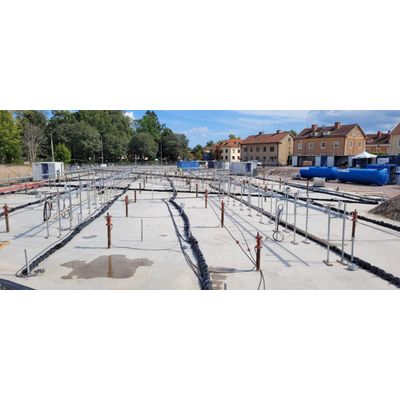
Geostream - In-Situ Thermal Technology
How It Works
McMillan-McGee (Mc2)’s patented ET-DSPTM thermal heating process introduces electrical current into contaminated soil via electrodes, which are strategically placed throughout a contaminated zone.
Using three-phase power, it transfers current to each individual electrode and heats the subsurface.
The heat transfer mechanism volatilises contaminants in-situ or drives them to extraction wells via. a guided steam front.
Electrical heating increases the temperature of the soil and groundwater by conducting current through the interstitial water that fills the porosity voids in soil.
ET-DSP benefits from the three dominant mechanisms of heat transfer:
- Conduction
- Convection
- Electrical heating
Application of convective heating, accomplished by injecting water at controlled rates into the ends of the electrodes where the electrical field has the highest density, makes ET-DSPTM more effective than rival technologies.
Without convective heat transfer, conventional remediation processes are limited by retardation of the contaminant in-situ, especially in fine sediments and clays.
This means primary technologies must be operated for long periods and may not achieve clean-up standards in low-permeability soils or where the vapor pressure of the contaminant is low.
The process can take years, whereas ET-DSP achieves a significant reduction in contaminant within 3 to 8 months. So far, it has been used successfully on >140 sites worldwide.