


Geotomographie GmbH
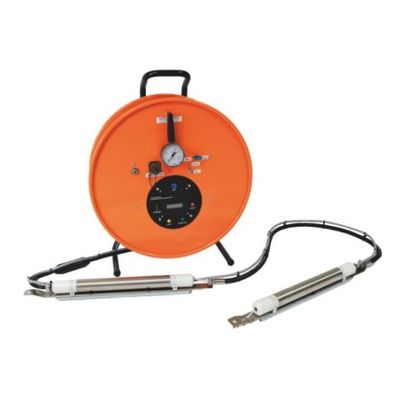
Geotomographie - Model DDS -Dual Downhole System
The Dual Downhole System (DDS) is used to receive P- and S-waves in dry and water filled boreholes in order to determine interval velocities. The DDS consists of two stations each equipped with tri-axial sensors. The stations are mechanically connected to each other to ensure the alignment of all horizontal sensors. Both stations are coupled to the borehole wall by a pneumatic clamping system (inflatable bladder). Air is supplied to the DDS through an electro-pneumatic hybrid cable with a Kevlar tension string. A magnetic compass shows azimuthal deviation to North and can be used to get the orientation of the DDS in the borehole. The cable is terminated by a connector to the seismograph.
Most popular related searches
borehole wall
borehole diameter
borehole receiver
borehole geophone
borehole
seismograph
water borehole
geophone
downhole geophone
borehole system
- Natural sensor frequency: 10 Hz (others on request)
- Sensor arrangement: Tri-axial
- Operational depth: 100 m
- Number of stations: 2
- Station interval: 2 m
- Station length: 620 mm
- Station diameter: 65 mm
- Station weight: 2.5 kg
- Cable weight per metre: 145 g
- Cable strength: 2150 N
- Borehole diameter: 75 mm
- Clamping system: Inflatable bladder
- Orientation: Magnetic compass (+/-2.5°)
- Depth indicator: Cable marking every 2 m
- Connector: To any seismograph
- Storage: On drum
- DDS (dual downhole system)/BGK (borehole geophone)
- Same source signal at each station: Source signal may vary from depth to depth
- Interval velocity independent of trigger time: Accurate trigger time needed
- Crosscorrelation traveltime analysis can be used to determine interval velocity: Errorneous traveltime picks may lead to unrealistic velocities