
GeoVista - Model ELOG -Normal Resistivity Probe
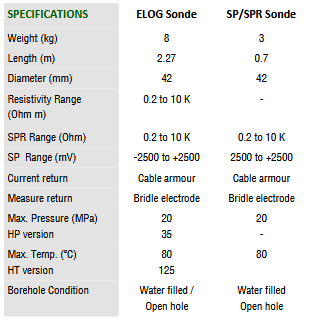
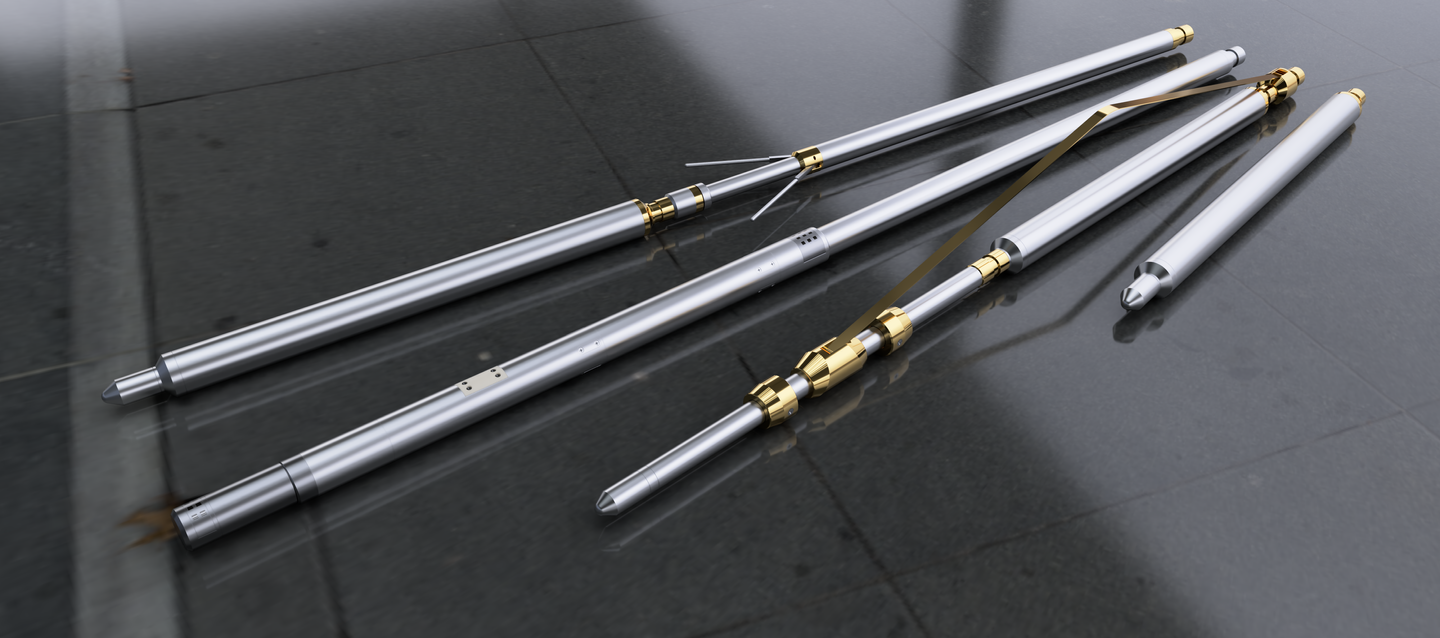
The Geovista ELOG probe records 16" and 64" normal resistivity, single point resistance (SPR), and spontaneous potential (SP) measurements. Resistivity logging is widely used in mineral exploration, hydrogeology, formation evaluation, and many other applications.
Resistivity is a fundamental property of materials and resistivity logging is one of the most mature geophysical logging techniques. The electrical resistivity of the strata is measured at 16" and 64" which provides a shallow and deep measurement. This is done by an generating a constant alternating polarity current of approximately 2 mA at a drive electrode which flows out from the source to the cable armour. The potential between the 16" and 64" electrodes is measured and this voltage is proportional to the formation resistivity in Ohm-Metres.
The SPR is the measured potential between the drive electrode and the 16" electrode. The measured voltage is proportional to the resistance of the formation in Ohms.
The SP measurement is a DC voltage measured in the presence of an AC current injected from the drive electrode. In certain circumstances, the SP is measured with reference to a surface electrode (Fish). The ELOG sonde requires a resistivity bridle for use which maintains separation between the drive electrode and the cable armour.
Resistivity logging is a staple in mineral exploration, water well drilling, formation evaluation, and many other applications. After natural gamma logging, it is probably the most widely used logging technique.