
Geovista - Spectral Gamma Probe
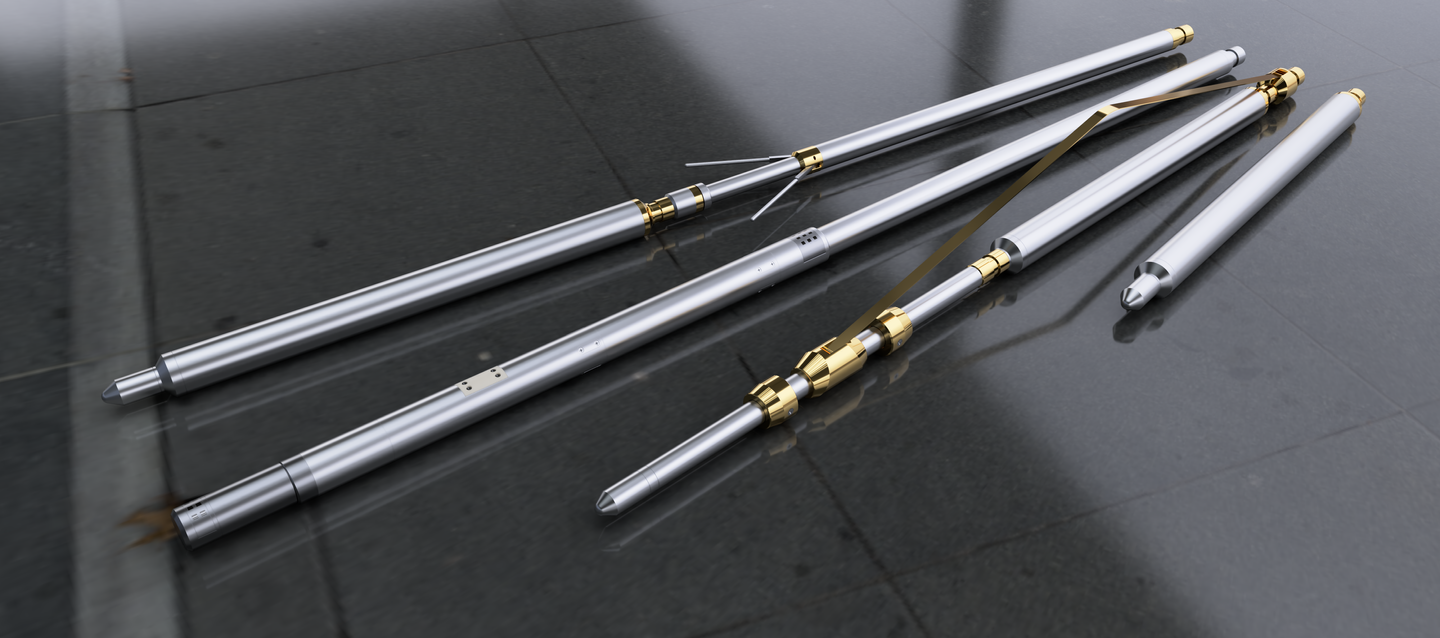
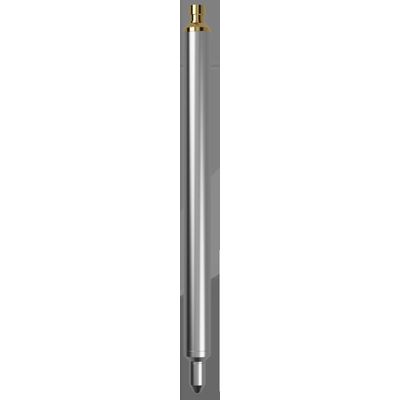
The Spectral Gamma sonde measures gamma ray energy to identify and quantify gamma emitting isotopes in strata. The sonde provides a total counts per second value and (if calibrated) a breakdown of K (%), U (ppm), and Th (ppm), calculated from the measured energy spectrum.
The Spectral Gamma probe measures the energy and intensity of gamma emissions from the formation. The main radioisotopes in geological strata are :33U, ^h, *°K, and various radionuclides the their decay chains. Each of these different isotopes emits gamma rays at characteristic energies that can be measured and used to identify the emitting nucleus. These data are then presented as a total gamma ray log which breaks down the abundance of K (%), U (ppm), and Th (ppm) with depth. As with the Natural Gamma Probe, the total gamma ray counts can provide limited lithological information. With the Spectral Gamma sonde, however, the breakdown of which radioisotopes are responsible for the emissions can provide a much more detailed picture of the mineralogy.
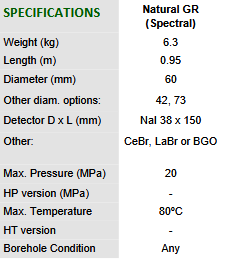
Several detector crystals are available depending on job requirements: Nal, BGO, CeBr, and LaBr. LaBr has the capacity to deal with high count rates and offers good output linearity with temperature. However, it can exhibit higher intrinsic background counts. CeBr is an alternative to LaBr and the crystals have the same form factor as Nal. It exhibits far fewer intrinsic background counts. BGO is a very efficient GR absorber due to its high Z. However, it can be susceptible to radiation damage. The table below summarizes these attributes: