


- Home
- Companies
- Gess-CZ, s.r.o.
- Products
- Gess - Screw Pumps
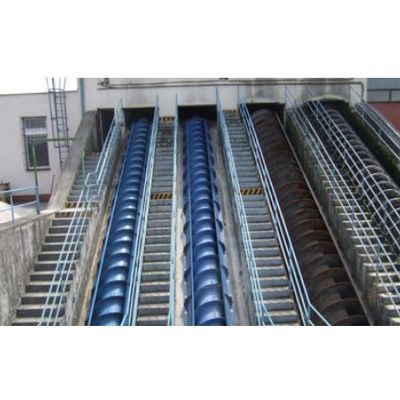
Gess - Screw Pumps
The first screw turbine in the world was designed and manufactured in 1997 in the Czech Republic. The construction uses an ancient pump called the Archimedean screw in reverse operation. A worm turbine is a gravitational mechanical machine that converts the potential energy (slope) of a water flow into mechanical energy and subsequently, thanks to a gearbox and a generator, into electrical energy. Water from the water flow flows through the channel into the trough of the screw turbine, inclined at a certain angle. Due to its weight, it acts on the blades of the screw part of the turbine rotor and slowly rotates the entire turbine. The power of the turbine depends on the flow and slope of the water flow.
- Self-supporting gutter
- Minimal use of concrete for anchoring the gutter
- Significantly lower construction costs
- Easier and faster installation
Worm turbines for newly built water works represent the vast majority of turbines produced. The installation of these turbines is associated with the construction of new or modification of existing water channels. The power plant is divided into a part for turbine mechanics and a part for electric current conversion. In this case, the steel trough is firmly connected to the concrete outdoor gutter. The turbine motor is stored separately on the floor of the building. The power plant consists of one or more turbines.
Implementations of our turbines can be found almost throughout Europe. In addition to our own assembly and service teams, in some countries we have partner companies with which we have long-term cooperation and whose employees we have trained ourselves and introduced them to our products. One of our goals is the long-term growth and delivery of our products and services to other countries.
- Significantly lower costs for the construction part of a small hydroelectric power plant
- Lower acquisition costs (approx. 30 - 40%)
- Use of low gradients - from 1.1 m
- Simple construction
- Long life
- High efficiency
- Reliability at low flow (even at 20% efficiency, efficiency is 74%)
- Mostly unattended operation and simple inspections
- Possibility of installation in the weir
- Easy access to active space