

- Home
- Companies
- Schroder Spezialglas GmbH
- Products
- Schroder Macor - Glass Ceramic
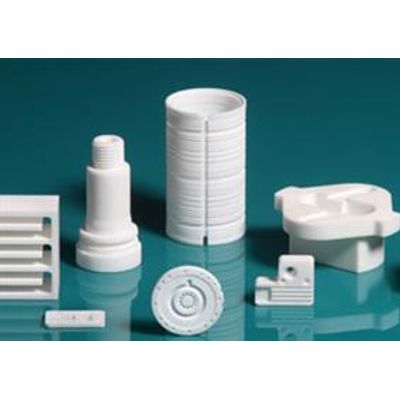
Schroder Macor - Glass Ceramic
MACOR is a glass ceramic that can be machined with cemented carbide or diamond tools. It consists of a glass matrix containing mica crystals. Its outstanding machinability makes a wide range of precision parts with complex shapes possible.
Fields of application
MACOR® is used for insulators and coil carriers in high- and constant-vacuum environments and for electrode and dielectric carriers in the electrical industry.
Main properties
- No porosity, no outgassing
- Low thermal conductivity
- Outstanding electrical properties
- Continuous operating temperature: 800 °C
- No sintering necessary
- Coatable with a variety of materials
Raw material dimensions
- Max. dimensions: 300 x 300 x 50 mm
- Special dimensions only on request
Machining MACOR®
- Machining speed and coolant are decisive for successful machining. Read all about the machining of MACOR® here.
MACOR® composition
- MACOR® glass ceramics consist of a glass matrix containing mica crystals. Its composition of 55 % fluorophlogopite mica and 45 % borosilicate glass gives rise to a microstructure that can be machined into complex shapes with conventional metalworking tools. Find out all about MACOR®’s composition here..
MACOR® semi-finished products
Schröder Spezialglas also offers its customers a variety of semi-finished products of this material in different shapes. These stocked materials are sold for various tests or further processing and can be purchased in small quantities.
MACOR® is an outstanding technical material offering huge benefits in terms of machining. MACOR® is a white, non-wetting, odour-free, non-porous and outgassing-free material.
It lends itself exceptionally well to machining. The production tolerances of MACOR® are surprisingly tight (+/- 0.01 mm, surface finish < 0.5 µm and polished < 0.013 µm) for complicated shapes. MACOR® remains uniformly stable at 800 °C, peaking at 1000°C without load. Unlike ductile materials, it will not creep or deform.
Its coefficient of thermal expansion is equal to that of most metals and glass solder. As an electrical insulator – particularly at high temperatures – the material is outstanding at high voltages and over a broad frequency spectrum.
- Easy to machine
- Resists high temperatures
- Low thermal conductivity
- Keeps to narrow tolerances
- Electrical insulator
- Non-porous, no outgassing
- Strong and rigid
- Highly polishable
- Can be brazed to many materials
- Radiation resistant
- Lead-free
- Constant- and ultra-high vacuum environments
- Laser technology
- Semiconductors/electronics
- Aerospace
- Chemical industry
- Automotive industry
- Military
- Nuclear industry