


- Home
- Companies
- Plansee India High Performance ...
- Products
- Glass Melting Eectrodes
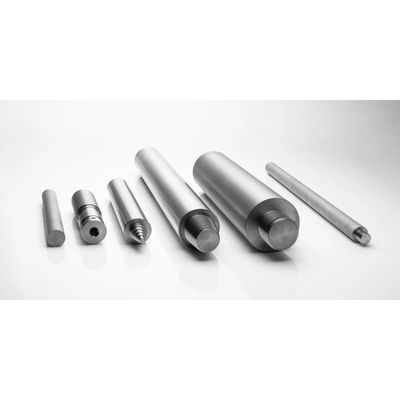
Glass Melting Eectrodes
Molybdenum glass melting electrodes: Molybdenum glass melting electrodes for electrically heated glass tanks must be able to withstand extreme thermal loads and aggressive glass melts. Our molybdenum is ideal for these difficult conditions. Thanks to a special forging process, the glass melting electrodes we manufacture possess a particularly smooth surface. In addition, our forming processes result in a particularly coarse-grained, creep-resistant material structure coupled with optimum straightness. This ensures that our glass melting electrodes do not deform, are less prone to wear, and last longer.
Your advantages at a glance:
- Highest purity for bubble-free application (min.99.97%)
- Best electrical and thermal properties
- Excellent creep resistance
- Excellent corrosion resistance
- Optimum protection against oxidation via a Sibor® coating
- Customer-specific solutions as well as standard products from stock
Low corrosion ensures a long service life for the electrodes
Molybdenum exhibits excellent corrosion resistance with regards to most glass melts. Low material removal rates are the deciding factor for a long service life of the glass melting electrode and also have a major influence on the final quality of the glass.
Molybdenum-zirconium dioxide glass melting electrodes
We offer glass melting electrodes made of MoZrO2 for glass production in particularly aggressive glass melts. Small quantities of zirconium dioxide (ZrO2) added to molybdenum enhance the properties of the pure material. MoZrO2 offers a particularly high level of corrosion resistance to glass melts as well as better creep resistance than pure molybdenum.
Oftentimes aggressive refining agents such as antimony oxide and arsenic oxide are used in glass melts. They harm the grain structure of pure molybdenum and lead to the rapid abrasion and breakage of the electrodes. MoZrO2 is able to withstand this aggressive environment. Even in brown and green container glass, the addition of zirconium dioxide is able to considerably reduce electrode corrosion.
Sibor - our oxidation protection for molybdenum
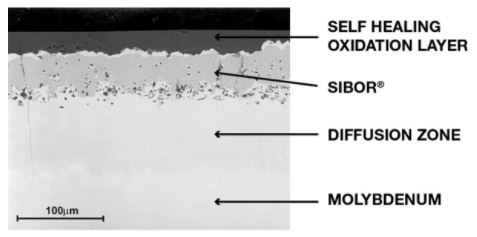
Molybdenum begins to oxidize at over 400°C. Sibor protects molybdenum from oxidation up to 1700°C (3092°F). The very hard, dense coating creates a diffusion barrier along the base material and forms an SiO2 seal against the air. Depending on the operating temperature, the material is protected against oxidation by the Sibor layer for up to 5000 h. Using Sibor, you can mount the electrodes right before heating the glass tank. This does away with the time-consuming and dangerous installation in the tank already filled with glass melt.
We manufacture our molybdenum glass melting electrodes from the raw material to the finished product in-house. We only use the purest raw materials as the source material. This is how we guarantee that our glass melting electrodes meet the highest requirements with a purity of at least 99.97%. This eliminates discolorations and bubble formation.
We have standard sizes in stock. But would you like a special dimension, mechanical machining, coating, a special thread, or cooling ducts? We would be happy to meet your specific requirements.