

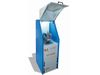
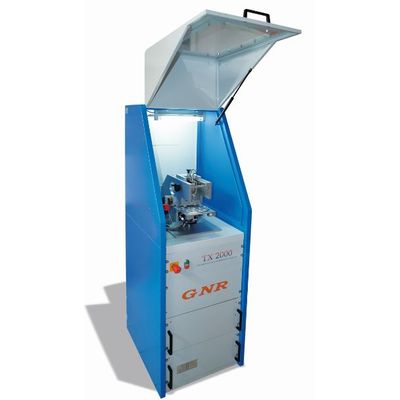
GNR - Model TX 2000 -Total Reflection X-Ray Fluorescence (TXRF) Spectrometer
An outstanding spectrometer that allows to perform Energy Dispersive X-Ray Fluorescence Analysis in Total Reflection Geometry. TX 2000 is the state of the art laboratory spectrometer for quantitative multi element trace analysis using Total Reflection X-Ray Fluorescence (TXRF).
TXRF is a type of Energy Dispersive X-Ray Fluorescence (EDXRF) in which the beam strikes the sample, deposited as a thin layer on a carrier, at a very small incidence angle, in order to exploit enhancement given by the total reflection effect.
As far as the sample is thin enough (thin film approximation), the tecnique’s main strenghts are:
- simultaneous multi-element analysis from Na to Pu
- no matrix effect
- no matrix-dependent calibration curves
- improved detection limits (LOD) down to ng/g or lower
- minimum amount of sample
- microanalysis capabilities
TX 2000, equipped with an automatic primary beam switching system (MoKa, WLa/Lb and bremsstrahlung 33 keV), a Silicon Drift Detector (SDD) and an high power X-Ray Tube is the optimal solution for applications in environmental, chemicals and nuclear fields.
- Stepper motors with optical encoders ensure extremely precise angular values.
- Enhanced excitation mode by selection of the most suitable monochromatized energy (W-La/W-Lb/Mo-Ka) provided by the combination of double anode MO/W X-ray tube and W/Si multilayer. Other X-Ray anodes can be monochromatized as well.
- Peltier-cooled Silicon Drift Detector with an energy resolution better than of 133eV (FWHM@MnKa, 1ms peaking time)
- Minimal distance between the sample and the detector (mounted to the axis normal to the plane of the sample).
- Instrumental detection limits below ng/g.
- Helium flux attachment to improve the detection limits for the light elements.
- No matrix effect
- Environmental Analysis: water, dust, sediments, aerosol (ISO/TS 18507:2015, ISO 20289:2018)
- Medical/Pharma: toxic elements in biological fluids and tissue samples, catalyst residues
- Forensic Science: analysis of extremely small sample quantities
- Pure chemicals: acids, bases, salts, solvents, water, ultrapure reagents
- Oils and greases: crude oil, essential oil, fuel oil, gasoline, jet fuel
- Pigments: ink, oil paints, powder
- Nuclear Industry: measurements of radioactive elements
X-Ray Generator
- Maximum Output Power: 3 kW
- Max Output Voltage: 60 kV
- Max Output Current: 60 mA
- Voltage Step Width: 0.1 kV
- Current Step Width: 0.1 mA
X-Ray Tube (*)
- TypeGlass, Mo/W anode, long fine focus
- Focus0.4 x 12 mm
- Max Output2.5 kW
- ^(*) Different anodes can be mounted on request
Multilayer monochromator
- TypeW/Si
- Reflectivity 80%
Excitation energies
- W-La8.4 keV (ΔE<1 keV)
- W-Lb9.67 keV (ΔE<1 keV)
- Mo-Ka17.44 keV (ΔE<1 keV)
- Bremsstrahlung33 keV
Sample Holder
- 12 position sample holder
Detector
- Active area: 40 mm2 as standard. (50 mm2 as option)
- Energy resolution: ≤ 133 eV FWHM @Mn-Ka (1 μs peaking time)
Atmosphere
- Air or He Flux
Case
- DimensionsWidth 580 mm, Height 1631.5 mm, Depth 793 mm
- weight200 kg (without chiller)
- Leakage X-Rays< 1 mSv/Year (full safety shielding according to the international guidelines)
Cooling
- External Chiller (1146h, 570w, 740d)
GNR proprietary software for TXRF supports several tasks of analysis, from Data Acquisition, having the full control of all the process and hardware settings (generator and tube, detector, measurements set up) to Data Analysis:
- Least square Marquardt fit procedure for the area calculation (spectral analysis)
- Automatic/manual search function
- Manual or automatic calibration of energy
- Quantification via an internal standard using theoretical and experimental sensitivity curves