- Home
- Companies
- Grabner Instruments - AMETEK
- Products
- Grabner MiniVap - Model VP/VPL Vision - ...
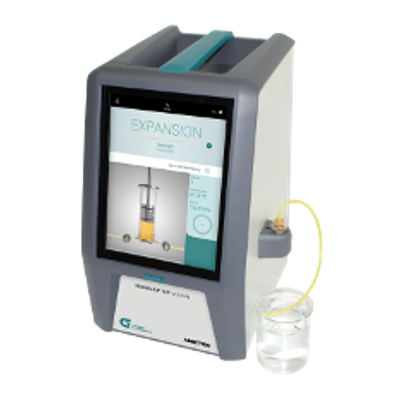
Grabner MiniVap - Model VP/VPL Vision -Portable Vapor Pressure Tester
MINIVAP VP Vision is a highly versatile portable vapor pressure tester that features best-in-class precision and a pressure range of 0-2000 kPa (290 psi). It is the first analyzer that demonstrates excellence in engineering by earning certificates for robustness and durability. Based on Grabner´s cutting-edge Cockpit™ technology, the instrument offers unmatched networking capabilities and enables worldwide access to analyzers.
Engineered for Excellence
MINIVAP VP Vision measures gasoline, jet fuel, crude oil, LPG and solvents. Long-term testing has demonstrated an unmatched repeatability. The newly developed Grabner 2D-Correction™ (273 points) and exact piston positioning guarantee that accurate and precise results are received over the full measuring range. MINIVAP VP Vision incorporates Grabner´s Sampling Pro™ valve design, which during ruggedness tests proved to be the best-in- class piston based design for minimizing cross contamination between various sample types.
Simplicity and Flexibility
The MINIVAP VP Vision uniquely combines ease of use with flexibility. A modern, app-like user interface makes it easy to select, start and follow measurements directly on the industry- proven 10” touch screen. With just a few clicks, measuring templates can be created and customized methods can be added. In addition, Grabner´s Cockpit™ PC software offers lab managers the utmost in flexibility. The software combines measurement results from multiple locations.
Access. Anywhere. Anytime.
With the Cockpit™ PC software multiple instruments are automatically recognized and devices all around the world can be configured, monitored, diagnosed, serviced and upgraded from one central lab. The software can be accessed through a secure VPN tunnel, allowing for true mobile access to instruments from any place at any time. A unique call home function facilitates easy uplink to our well trained support team.
Durability and Robustness
The MINIVAP VP Vision is the first vapor pressure tester certified to work in cold, hot and damp heat climate. It has demonstrated an ability to withstand vibrations and heavy shocks coming from any direction. This instrument is ideal for use in mobile laboratories, in military applications or in harsh environments.
Most versatile, most complete
MINIVAP VP Vision comes fully configured to run all major vapor pressure methods. Every analyzer incorporates an integrated shaker for Crude Oil with adjustable speed.
Highest Accuracy - Lowest Limit: Low Volatility Model MINIVAP VPL Vision
While the standard VP model is designed to sustain pressures up to 20 bar, some applications require increased measurement sensitivity for samples with a very low volatility. These applications include e.g. the measurement of Diesel, Oils or Flavors & Fragrances. The MINIVAP VPL Vision model is designed for low volatility measurements with a pressure range of 0 to 150 kPa (22 psi). It shows a measuring repeatability of ±0.11 kPa (0.01 psi) and reproducibility of ±0.20 kPa (0.02 psi) for low volatile samples.
Direct / Indirect Determination of the Absolute Vapor Pressure ("VOC-Methods")
The model MINIVAP VPL Vision was developed to automate the manual ASTM D2879 Standard Test Method for Vapor Pressure by Isoteniscope for low volatile samples, which is used by the chemical industry. The instrument incorporates a direct and an extrapolated "VOC" method for absolute vapor pressure measurement of single- and multi-component samples.
The direct "VOC"-method is a static method for determining the absolute vapor pressure required for safety data sheets. The indirect method additionally allows to extrapolate to extremely low pressures or to temperatures that exceed the instruments temperature range (-100°C to +300°C). Both methods yield results comparable to the static ASTM D2879 Isoteniscope method, but do not require sample evacuation prior to testing. Based on the GRABNER Triple Expansion Method, air/gases are removed automatically from the measurement result and the sample composition is maintained during measurements.
"VOC"-methods are available in both the MINIVAP VPL and the VP Vision analyzer. Because of a better sensitivity for low volatile samples, the precision of the VPL Vision is significantly better in the pressure range.
Minivap Vp Vision Vapor Pressure Tester Complies With:
- ASTM D6378 - Vapor Pressure of Gasoline (VPx)
- ASTM D5191 (Dry Vapor Pressure Equivalent)
- ASTM D6377 - Vapor Pressure of Crude Oil (VPCRx)
- ASTM D6897 - Vapor Pressure of LPG up to 2000 kPa
- ASTM D5188 - (V/L-Ratio)
- EN 13016 - 1 (Air Saturated Vapor Pressure)
- EN 13016 - 2 (Absolute Vapor Pressure)
- IP 394 & 409 & 481
- JIS K2258-2, SHT 0769, GOST 52340
- US EPA approved Grabner test method for highest accuracy
Excellent Correlation To:
- ASTM specified correlation to D323 (Wet Reid)
- ASTM specified correlation to D4953 (Dry Reid)
- ASTM D5482 (Mini-Method, atmospheric)
- ASTM D1267 (LPG)
- ASTM D2879 (Isoteniscope method)
- REACH static vapor pressure test method
Other Available Methods:
- ASTM D5188 & D5191 Fast ModeTM method
- TVP - True Vapor Pressure of Crude Oils (FW 2.0)
- Direct and Indirect VOC Low Volatility Methods
- Custom Single and Triple Expansion Methods
Relevant Fuel Specifications:
- ASTM D4814 (Automotive Gasoline)
- EN 228 (Automotive Gasoline)
- ASTM D910 (Leaded Aviation Gasoline)
- ASTM D6227 (Unleaded Aviation Gasoline)
- ASTM D1655 (Aviation Turbine Fuels)
- ASTM D1835 (LPG)
Key Features:
- Unmatched precision for the VP measurement of gasoline and aviation fuels, crude oil, LPG, hydrocarbon solvents and chemical compounds
- Pressure range from 0 - 2000 kPa
- Unique 2-D Correction™ to ensure highest measuring precision over the full testing range
- Built-in shaker to generate rapid equilibrium for crude oil and V/L tests
- Smallest sample size: 1 ml w/o rinsing
- Fast measurements: Results in 5 minutes
- Automatic sample introduction and cell cleaning through piston-based design
- No vacuum pump or sample preparation necessary!
- Sampling ProTM valve design, best in class for minimizing sample cross contamination
- Thermoelectric temperature control - no external cooling necessary
- Maintenance free through central lubrication system; rapid oil refill w/o disassembling
- Cleanable, reuseable filter assembly
- 10“ industry-proven full color touchscreen
- Modern, app-like user interface with big buttons; works also with gloves - no stylus required!
- Customizeable measurement templates
- Unique PDF results sheet with pressure and temperature graphics
- Fast Mode™ Method: Runs D5191 and D5188 in combination
- Full calibration history and calibration backup function
- Certified for use in cold, dry and damp heat environment (EN60068-2-1, EN 600068-2-78, EN 60068-2-14)
- Shockproof and vibration-resistant portable design (EN 60068-2-6, EN 60068-2-27)
- Ideal for laboratory and field use
- 2 years warranty
Cockpit™ PC Software
Includes license for Grabner Cockpit™ PC software. For automatic instrument recognition, worldwide analyzer uplink and centralised results and statistics management. Enables remote user management and user training, remote device configuration and software update, remote diagnostics, online support and calibration checks.
Options / Accessories
Crude oil package for MINIVAP VP Vision available. Due to the instrument´s extended pressure range no pressure regulator is required for filling pressurized samples!
- Temperature Range : Measured: 0 to 120°C (user programmable)
- Extrapolated: -100 to +300°C
- Temperature Stability : ± 0.01°C
- Temperature Profiles : Single temperature, multipoint, curve, extrapolation
- Pressure Range : VP Vision: 0 to 2000 kPa (0 to 290 psi)
- VPL Vision: 0 to 150 kPa (0 to 21.8 psi)
- Pressure Resolution : 0.01 kPa
- Precision : Repeatability: ≤ 0.2 kPa (pure substance @ 37.8°C)
- Reproducibility: ≤ 0.5 kPa (pure substance @ 37.8°C)
- Vapor-Liquid Ratio : 0.02/1 to 100/1, depending on method
- Sample Volume : 1 mL (2.2 mL per rinsing)
- Measurement Time : ~ 5 min., depending on method
- Results Database : > 100.000 detailed results w/ graphics stored on the instrument
- Results Download : csv, PDF w/ graphics
- Instrument OS : Microsoft® Windows®
- Instrument Electronics : Intel® industry PC 10” industrial full color touchscreen 24 bit ADC
- Instrument languages : en / de / fr / es / pt / it / ru / ar / zh / ja; customizeable
- Interfaces : 2x USB, 2x LAN (1x DVI-I, 1x RS 232) Operation / Environmental Cond. : 0 - 50°C, 93% r.H. non condensing acc. to EN 60068-2-1, EN 60068-2-78, EN 60068-2-1
- Shockproof : acc. to EN 60068-2-6 (req. (IEC 60721-3-2, Class 2M2)
- Vibration resistant : acc. to EN 60068-2-27 (req. IEC 60721-3-2, Class 2M2)
- Power Requirements : 100-264 V AC, 45-63Hz, 80W (Switching Power Supply)
- Field Application : DC/AC Power Converter 12V
- W x H x D : 293 x 390 x 280 mm (10.5 x 15.4 x 11 in.)
- Weight : 10.5 kg (28 lb)
The sample is contained in a 10 mL syringe (3) or in a sample container for direct sampling. The automatic sample introduction and the volume adjustments are made by a piston with an integrated pressure transducer (1). The measuring chamber (2) with a total volume of 5 mL is automatically rinsed and filled with 1 mL for the measuring process. After closing the valve (4) driven by the valve motor (5), the volume expansion to 5 mL (with the sample under vacuum condition) is obtained by a further stroke of the piston. The temperature of the measuring cell is controlled with a high-power thermoelectric module (6) and measured with a precision Platinum RTD sensor (7). After the sample introduction and the volume expansion, the test temperature is adjusted. After the equilibrium time, the measurement of the dissolved air is completed. Test results of DVPE, ASVP, Pgas and Pabs are displayed and printed.
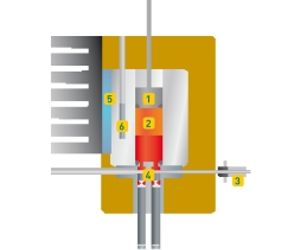
Automatic piston lubrication is processed with every piston stroke.