


- Home
- Companies
- Plasti-Fab EPS Product Solutions
- Products
- Energreen - Model GPS - Graphite ...
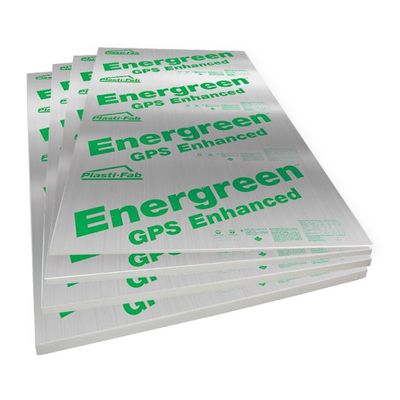
Energreen - Model GPS -Graphite Polystyrene (GPS) Rigid Foam Insulation Board
Energreen GPS Enhanced insulation is a Type 1, Type 2, and Type 3 moulded graphite polystyrene (GPS) rigid foam insulation that gives maximum efficiency, cost-effectiveness and sustainability to your insulation projects. Energreen GPS Enhanced is manufactured using Neopor provided by BASF, a graphite-enhanced raw material that reduces radiation heat transfer resulting in higher thermal resistance (R-value) compared to standard CAN ULC S701.1.
With an R-value of 4.7 per inch, Energreen® GPS Enhanced helps you achieve your desired R-value with a thinner board. Energreen® GPS Enhanced insulation is easy to work with and install, and consistently delivers the highest true R-value performance over time. This high-performing insulation is breathable, while the closed-cell structure does not support the growth of mold, while adapting to all climate zones.
The higher compressive strength of Energreen® GPS Enhanced makes it an excellent choice for under slab and below grade applications. Not only does it maintain its R-value for the life of the product, but provides the compressive resistance needed to meet strict building codes.
Energreen® GPS Enhanced insulation resists water absorption so it will retain its R-value even in applications where temperatures fluctuate. Markings provided on the printed face of Energreen® GPS Enhanced insulation assist in cutting to required dimensions and spacing of fasteners into framing.
Available in:
- 4x8 ft; 2 ft high bundles
- Thicknesses of 3/4, 1, 1 ½, 2, 2 ½, 3 in. plus special order sizes
- Easy to cut and install
- Meets CAN ULC S701, Type 1,2,3
- Closed cell insulation
- No Thermal Drift
- Compressive Resistance of 10 psi
- A True R-value of 4.7 per inch
- Resistant to moisture
- Uses up to 30% less material than other rigid foam insulation to achieve the same R-value, saving on building materials and installation labor
- Thinner boards are needed to reach the desired R-value than others so the same effect is achieved with less material