

- Home
- Companies
- WaWaTech – Wastewater Technology Sp. z ...
- Products
- WaWaTech - Model inDENSE - Gravimetric ...
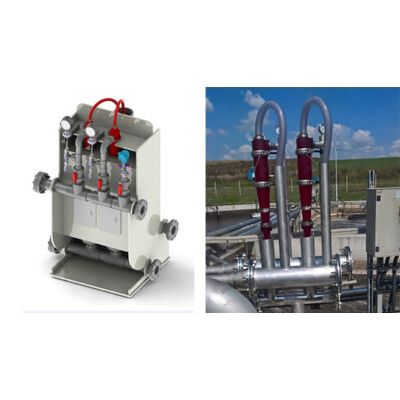
WaWaTech - Model inDENSE -Gravimetric Selection Process for Wastewater Treatment
The inDENSE™ Gravimetric Selection Process is a wastewater treatment solution designed to enhance sludge management by optimizing biomass density. This process deploys hydro-cyclones, operating at pressures of 2.0 to 2.5 bar, to segregate lighter sludge fractions while concentrating denser biomass components enriched with Phosphorus Accumulating Organisms (PAO). These organisms aid in the biological phosphorus removal and contribute to improved sludge settling through their poly-phosphate cores. By enhancing the settling properties and densification of biomass, the inDENSE™ system supports increased throughput and efficient design of wastewater treatment facilities, either reducing tank volumes or raising plant capacity. This approach helps in maintaining sludge retention, mitigating washout, and avoiding bulking issues, proving effective in various installations worldwide. It is particularly beneficial for retrofitting existing plants or downsizing new installations to optimize space and resource use.In biological wastewater treatment solutions the main goal of the operator is to keep the (activated) sludge in the system. To prevent a washout (on final clarifiers) it’s important to have a sludge that settles well. Better sludge settling can be realised by biological or physical selection of preferred types of bacteria. Such selection is promoted with inDENSE™. inDENSE™ system increases process throughput and performance through the selection of dense sludge aggregates with improved settling rates and the promotion of enhanced biological phosphorus removal (EBPR).
The brand ‚inDENSE‘ stands for ‚Process intensification by densified biomass‘. The settling properties of the biomass are the base for process design and higher settling rates reduce tank volumes or increase plant capacity, respectively. For the inDENSE™ process hydro-cyclones are applied to separate out the light and fluffy sludge fraction which is fed to waste-sludge processing.
The sludge-fraction in the cyclone under-flow contains denser biomass with a higher portion of Bio-P organisms. These Phosphorus Accumulating Organisms (PAO) grow preferentially under anaerobic niche-conditions in densified biomass and contain poly-phosphate-cores which add weight for an efficient selection process.
The process goals are:
- Improve sludge settling performance, prevent solids wash-out
- Allow for higher mixed liquor concentrations, capacity increase
- Enhance or stabilize biological P-removal
Hydro-cyclones are applied to achieve the described selection performance. These cyclones are fed with mixed liquor or recycled sludge at an operating pressure range of 2.0 to 2.5 bar. Driven by centrifugal forces about 10-20% of the feed-flow and about 1/3 of the mass-flux are separated out in the cyclone under-flow and recycled to the treatment process. To support the physical selection, a biological selection is provided under anaerobic conditions and high substrate gradients in a defined selector zone. This biomass is retained and enriched in the system by the hydro-cyclone, while the light sludge-fraction gets wasted.
This way inDENSE™ allows intensified usage of tankage, decreasing the volume requirement for green-field plants or increasing capacity of existing plants, respectively. Additionally, inDENSE™ is applied to prevent solids wash-out and bulking issues.
So far, inDENSE™ has been successfully implemented at several plants.
- Smaller bioreactors. Due to possibility to increased level of MLSS.
- Smaller final clarifiers. Due to improved sludge settling, lower SVI.
- Enhanced Bio-P activity – Biomass minimizes demand for chemical phosphorus precipitation.
- Low fine particles – Sequenced settling of the sludge blanket forms a floc-filter which reliably removes fines, producing an effluent low in suspended solids suitable for water reuse.
- Simplicity at first!
- Not sensitive to process changes like in the bacteriological selectors or contact tanks.
- Easy integration in any existing kind of activated sludge system.
- Innovative yet proven technology – more than 100 reference plants.