

GRAVIFLOW - Model CLAP-17 -Gravity Hydraulic Flow Meter
The GRAVIFLOW CLAP-17 hydraulic flow meter is a high-precision device designed for measuring flow in gravity-fed fluid systems. Unique among flow measurement devices, it requires no upstream or downstream length, thanks to its innovative technology. This Plug & Play flow meter integrates seamlessly into existing infrastructures without modification or calibration. It features a data logger with time-stamping, volume calculations, and control functionalities for connected devices like samplers and valves. Particularly useful in stations for pumping, wastewater treatment, and overflow regulation, this device offers reliability even in varying flow conditions.
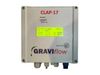
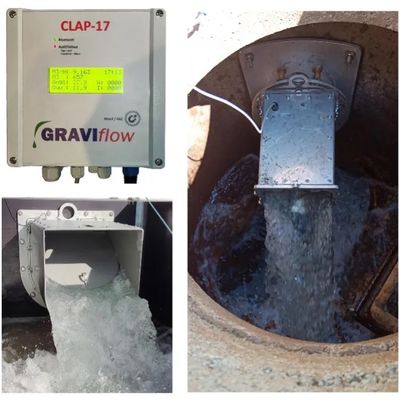
The CLAP-17 flow meter from GRAVIFLOW consists of a measuring cell forming a channel equipped with a non-return valve articulated on a horizontal axis, perpendicular to the flow of the fluid to be measured.
An accelerometer type sensor is attached to the non-return valve which indicates its position in relation to the vertical axis.
The fluid exerts a hydrodynamic force on the check valve pushing it in the direction of flow.
The non-return valve tends to close by the sole effect of its weight .
These two forces balance each other at every moment.
From the measured value of the opening angle, the patented algorithm of the GRAVIFLOW hydraulic flow meter calculates the value of this balance, thus determining each point of the angle/flow curve .
The check valve is positioned at a unique opening angle for each flow rate, independent of the flow regime.
This results from the law of conservation of energies from which the GRAVIFLOW algorithm is inspired.
This decisive innovation in the principle of flow measurement means that the CLAP-17 flow meter from GRAVIFLOW is the only one to truly free itself from the flow regime .
The high precision mechanical execution allows reliable and durable measurement .
The technology of our flow meters is tested and validated on a hydraulic test bench .
The tests confirm that the measurement is effective in all flow conditions : laminar, fluvial, turbulent and variable.
A calibration certificate is provided with each device.
The concept of the CLAP-17 flow meter was born from the problems encountered on numerous projects by the designer of the GRAVIFLOW hydraulic flow meter, then an installer.
The topology of existing structures, not intended for measurement , is a serious obstacle that has become non-existent thanks to the technology of the GRAVIFLOW CLAP-17 hydraulic flow meter .
The self-control of discharges into the natural environment by sanitation networks, in particular by overflow into storm overflows , faces technical or financial difficulties to resolve.
Simple to install and economical, our measurement solution solves this double problem.
The CLAP-17 flow meter can be integrated into existing structures without constraints or civil engineering work .
LOCAL
- Display : flow, volume, angle and downstream height (if available)
- Bluetooth communication: access to all measurements, control functions and parameter adjustment (pulses, thresholds, etc.)
TRANSMITTED REMOTELY
- Instantaneous flow : in real time (4-20mA output)
- Counting pulses : programmable to the nearest liter
- Alarm on threshold : flow rate higher or lower than the setpoint
- Fault : blockage or internal fault
- Management of downstream influence (requires an additional level probe)
- Data Logger : Time stamping, storage of measurements, and calculation of reports
The measurement and report files can be used directly on a spreadsheet (Excel or compatible) - Secure control of samplers : volume, programmable to the nearest liter
- Flow regulation : control of external devices (valves, pumps, etc.)
- Very low consumption : isolated sites
- Anti-return function : improvement of sealing by seal
To meet regulatory requirements, operators are required to instrument certain structures such as storm overflows to count and date the quantities of effluents poured into the natural environment.
The instrumentation chosen must estimate or measure the flow rates and volumes discharged taking into account the number of equivalent inhabitants or BOD5 load (Biological Oxygen Demand for 5 days).
The necessary traceability of these measurements or evaluations requires reliable equipment and periodic monitoring of the device.
SUITABLE FOR ALL TOPOLOGIES
The Graviflow hydraulic flow meter is compatible with all these constraints:
- Reliable and fair measurement
- In situ metrological checks without dismantling the flow meter
- Simplicity of maintenance
Whether the flow meter is fully submerged, partially submerged or not submerged, the measurement remains effective.
The metrological control procedure proposed by Graviflow is validated by water agencies, water police and control bodies.
It can be carried out by operator personnel or by official inspection bodies.
Flow and volume inlet, bypass or outlet of wastewater treatment plantInlet, outlet and bypass flow rates in wastewater treatment plants are often variable to considerable extents.
The variation in flow rate makes the use of certain measuring devices unsuitable, particularly at low flow rates, for which deposits can be created over time in the pipes and cause measurement drifts.
These drifts lead to significant cumulative counting and totalization errors.
The Graviflow hydraulic flow meter, recognized and validated by the water agency as a measuring device , is not very sensitive to drifts of this type.
The measurement range is from 1 to 1000.
The accuracy is better than 98% and allows precise accounting whose cumulative error does not exceed 3% error.
Graviflow`s CLAP -17 is not sensitive to flow conditions and requires no straight lengths upstream or downstream.
Mounting accessories are available for all configurations and topologies encountered in existing installations.
Flow rate and volume at pumping station inletIMPLEMENTATION DIFFICULTY SOLVED
The mounting versions available, applied upstream on the wall of the station or on a flange at the end of the pipe , allow installation directly in the station upon arrival of the effluent.
Effluents , even those not screened, are counted over a very large range of flow rates.
The quality of the machining of the Graviflow flow meter prevents any adhesion of suspended matter such as wipes or residue of any kind.
Immersed or not, the Graviflow flow meter ensures precise 24-hour metering regardless of the variability of inlet flow rates into the station.
It is very difficult to instrument the gravity inlets in the pumping stations.
In fact, the supply pipes often arrive directly into the station, the lower part being able to be submerged, and therefore not allowing the installation of a traditional measuring device.
The Graviflow hydraulic flow meter solves this problem with its small footprint and ease of assembly.
Inlet flow rates that are too high or pump faults can cause pumping stations or stations to overflow.
It is essential to avoid any spills by detecting them early.
The CLAP-17`s very low flow detection capacity ensures this monitoring function.
The Graviflow flow meter also ensures the counting of spilled volumes.
MULTIPLE LOCATIONS
The overflows from existing pumping stations are most often a pipe starting from the upper part of the station.
It is then difficult to equip these points because of accessibility and available space.
Graviflow hydraulic flow meter technology solves this problem efficiently and economically.
The flow meter can be mounted very simply inside the station directly on the wall of the tank, surface-mounted at the outlet of the discharge pipe.
Another option is to position the Graviflow flow meter in-line on the overflow line, as in the example below.
When flow rates vary significantly across a network, with values that can be very low, some metering devices cannot operate over the entire measurement range.
Speed height type equipment is limited by a minimum flow rate due to the need to cover their speed sensor.
Below this minimum flow rate, often greater than 10% of the nominal flow rate, the speed measurement is not carried out and the flow rate evaluation is imprecise.
Furthermore, it is not always possible to respect the upstream and downstream conditions required by these devices.
MEASUREMENT STABILITY
A rapid accumulation of mud covering the speed sensor, mainly installed on the water line of the pipe, leads to ineffectiveness of the measurement.
These constraints result in under- or over-counting.
The Graviflow valve flow meter solves this problem because the technology for measuring the opening angle of the valve is very precise from very small openings and does not suffer any drift over time.
No minimum flow rate is required to produce a reliable measurement.
The movement of the liquid produces a natural self-cleaning by the shape of the passage in the channel of the CLAP-17 Graviflow flow meter, thereby reducing the need for frequent maintenance.
EASY IMPLEMENTATION
The two examples above demonstrate the simplicity of installing the GRAVIFLOW hydraulic flow meter in existing manholes.
In example 1, it was enough to level the existing pipe entering the manhole and install the CLAP-17 applied to the wall of the manhole using a sheet metal part supplied by Graviflow.
Example 2, in the video, illustrates a CLAP-17 in a removable version, positioned by guiding its upstream support between two angles, fixed to a simple concrete waterproofing patch.
Storage installations intended to limit flow peaks on the networks, such as storm basins for example, require emptying with a controlled flow rate.
The drain flow rate can be conditioned by downstream parameters which require the implementation of a regulation, operating on a valve, a pump or any organ influencing the flow rate.
The proposed function allows the control of the regulation device according to a setpoint adjustable by the operator.
The proposed regulation range is within a wide range of flow rates ranging from 5% and 95% of the flow meter`s nominal flow.
OPTIMIZED FUNCTION
The specificity of the Graviflow hydraulic flow meter regulation function lies in an algorithm favoring precision and responsiveness.
It is optimized for controlling an all-or-nothing valve.
The safety of the valve, in addition to the limit switches, is achieved by adjusting the maximum and minimum durations of continuous operation of the actuator.
The regulation is very reactive: the target flow is reached very quickly by continuous opening or closing until the target flow is reached.
The algorithm then switches to PI type fine regulation mode with gain and dead band configurable by the operator.