

GreasezillaSM - Model 101 -Fats, Oil & Grease (FOG) Separation Systems
Greasezilla’sSM patented separation technology solves FOG treatment and disposal challenges worldwide. GreasezillaSM systems produce an advanced biofuel (Brown Grease) with a moisture content of less than 1 percent. GreasezillaSM offers an ecological and profitable alternative to chemically treating, lagooning, landfilling, incinerating, or dumping FOG waste.
FOG Waste is a costly headache that can be highly profitable. Greasezilla? solves FOG treatment and disposal challenges worldwide
Greasezilla is a leading cleantech provider in the FOG and UCO separation industries, solving FOG processing and disposal challenges for water recovery facilities, grease haulers, industrial food processors and managed waste sites worldwide.
Greasezilla ecologically processes and repurposes the FOG waste stream into water and clean energy resources, including a low carbon intensity bio feedstock for renewable diesel and sustainable aviation fuel production. Greasezilla systems enhance sustainability measures, help to minimize greenhouse gas emissions, protect wastewater infrastructure and reduce the amount of waste dumped in landfills.
Greasezilla? is a turnkey standalone system that optimizes FOG separation while producing a high-quality Brown Grease advanced biofuel offtake. Greasezilla’s? patented technology can be used for complete separation, providing a purely ecological sound alternative to chemically treating, lagooning, landfilling, incineration or dumping FOG waste. By running entirely on five percent of the advanced biofuel it harvests, Greasezilla? is the most cost-efficient and ecologically responsible Brown Grease separator available.
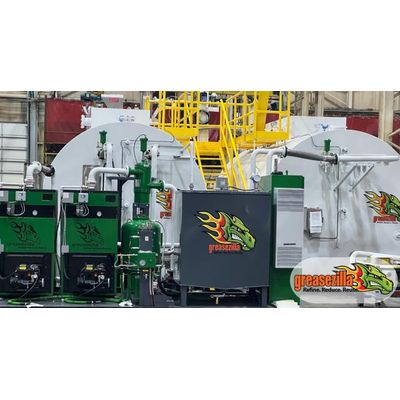
GreasezillaSM systems are available in modular or cylindrical formats to accommodate interior or placement.
The hydronic thermal process circulates through the grease trap waste, promoting stratification, and producing valuable brown grease advanced biofuel (ABF).
- Divert FOG from the waste stream.
- Reduce waste disposal expenses.
- Create new revenue.
- Run a cleaner, more eco-friendly operation.
Simple to Integrate
- Allen Bradley® Programmable Logic Controller SCADA integration for remote monitoring
- Scalable and modular to meet changing needs
Ecological
- Captures FOG in waste streams
- Recovers a low carbon intensity brown grease advanced biofuel (ABF), used as a feedstock for
- renewable diesel, and sustainable aviation fuel
- Burns a small fraction of the advanced biofuel it produces to fuel the separation process
Cost-Effective
- No expensive polymers or additives
- Significantly reduces costs associated with FOG treatment and disposal
- High EBITA / Quick ROI
- Assured revenue from sale of brown grease
Industry Advantages
- Promotes best practices to protect sewer infrastructures and plant headworks
- Manages entire FOG handling process
- Offers biofuel producers a low carbon intensity, cost-effective feedstock eligible for RIN credits under the Renewable Fuel Standard
Greasezilla? is a turnkey standalone system that separates and processes FOG waste. The system’s grease-separating process enables the operator to remove FOG from the grease trap waste stream, reduce waste disposal expenses, create new revenue and run a cleaner, greener, more eco-friendly operation. No additives, additional processing, blending, or fossil fuels required.
Greasezilla? operates without dewatering, leaves nothing to be landfilled, and has a total operating cost of 1-2 cents per gallon. The separation process produces a high-quality advanced biofuel making Greasezilla? the ideal front-end pretreatment system for FOG waste.
The Greasezilla? unit runs on brown grease; a small fraction of the brown grease produced in each batch is pumped back into the system and used as fuel.
Greasezilla? eases the financial sting of ever-increasing disposal fees, labor costs and transportation expenses associated with trips to further treatment and waste water plants. In addition, it creates new revenue streams by generating a high-quality brown grease salable commodity and through processing fees from other pumpers.
Greasezilla? also refines used cooking oil (UCO) into a premium, low-moisture yellow grease, ideal for biodiesel conversion processes.
Greasezilla’s? design provides site agility, allowing the system to be placed near the source of FOG creation. A standard system includes dual 10,000-gallon, double-wall, insulated steel tanks. As one tank heats and separates inputs, the other can be harvested, drained and reloaded. Once ingested, Greasezilla’s chemical-free separation process begins to divide the FOG waste into layers.
- Brown Grease, approximately 5-10 percent of the finished process, is recycled into Brown Grease Advanced Biofuel. Five percent of the ABF returns to fuel Greasezilla®, and the remaining 95 percent can be used for other heat requirements at the plant or as a salable fuel substitute on the commodities exchange.
- Batter, making up 5-10 percent of volume, can serve as an excellent feedstock for anaerobic digesters. It can also be treated with traditional processes, composted or be processed with the effluent water.
- Residual pasteurized water, comprising approximately 80-85 percent of the material and nearly free of suspended solids, can be safely discharged to a wastewater treatment facility or used for irrigation in drought-impacted regions.
- Systems are available for interior or exterior placements
- Is easy to operate and maintain
- Is modular and designed to be expandable and scalable
- Removes FOG from the waste stream
- Processes it into a biofuel, reducing greenhouse gas emissions
- Creates pasteurized, headworks-ready effluent water
- Creates instead of consuming resources
- Uses hydronic fluid rather than steam for heat transfer, eliminating scaling
- Requires no flocculants, polymers or other costly additives
- Exhaust emissions have no detectable color or odor
- Burns a small fraction of the very fuel it produces
- Processes 8-10 million gallons per year
Cost- Effective
- Eliminates costs associated with dewatering, drying, lagooning, land applying, incinerating, composting.
- Significantly reduces post treatment hauling volume and costs
- Greasezilla owners capture disposal fees from area haulers
- Generates revenue through the sale of the biofuel offtake
Reduces landfilling
- Greasezilla’s ecological process leaves virtually nothing to be landfilled
Ecological process
- Greasezilla separates FOG without using polymers, flocculants or chemical additives
Supports clean energy
- Greasezilla produces renewable biofuels feedstock for the biodiesel, renewable diesel and sustainable aviation fuel sectors
Low operational costs (OpEx)
- Greasezilla’s process runs on a small fraction of the ABF it generates and uses only a small amount of electricity to power the control unit
Highly profitable
- Greasezilla’s IRR demonstrates high profitability that results in an ROI of less than 2 years, even when the system is operated at half capacity
Simple to operate and maintain
- Greasezilla is a turnkey system requiring minimal staffing
Small footprint
- Greasezilla’s standard two reactor system requires a footprint of only 1000 square feet
Quick and efficient process
- Greasezilla’s separation process takes approximately 24-36 hours and features SCADA-integration for remote monitoring
FOG is the collective term for the waste grease byproduct that stems from cooking protein. FOG is created every day in residential, commercial and industrial settings where food products are produced, prepared or consumed. In residential areas, small amounts of FOG are generated when cooking meals. Towns and cities encourage their residents to minimize the amount of grease they put down the drain. However, in commercial food service establishments and industrial food processing facilities, FOG is generated in large quantities. Interceptors and wash down processes designed to capture FOG need to be constantly monitored and maintained to prevent FOG from passing into the sewer system.
According to the EPA, every restaurant can produce between 800 and 17,000 pounds of FOG per year, amounting to billions of pounds of FOG waste annually. Concern over the massive amount of FOG generated by the food processing sector has led to strict regulations and steep penalties for noncompliance. On the federal level, mismanagement of FOG violates the Clean Water Act, enforceable by the EPA through court-approved consent decrees. Consent decrees mandate a comprehensive remediation plan that can take years to complete at enormous cost to local taxpayers. Currently, dozens of consent decrees are being enforced across the U.S.
Even if FOG is properly collected, disposal is still a problem. Grease Trap Waste (GTW) is typically transported to and dumped at receiving stations located at a relatively few municipal sewage (POTW) or commercial wastewater treatment plants where haulers pay fees of $.05-$.30/gallon (US Data). While most communities have instituted FOG abatement programs at the commercial level and education programs for consumers, few are addressing what happens to Grease trap waste once it is collected. This can result in grease getting dumped untreated into sewer systems and causing sanitary sewer overflows. Rising disposal costs have led some municipal governments to subsidize tipping fees in an attempt to prevent illegal dumping, with limited success.
Three-quarters of the sewage collection infrastructure in the United States is so clogged and damaged by brown grease that sewers are estimated to be functioning at only half their capacity. In the U.S., approximately one of every two dollars allocated to sewer line maintenance is spent to repair grease clogs and other grease-related damage. According to the Wall Street Journal (June 2001), local governments spend $25 billion a year to remediate grease-related issues — such as blockages, backups and overflows — to keep the sewers flowing.
Traditional methods of treatment and disposal include dewatering, drying, composting, land application, incineration, and landfilling. All these methods are cost additive and do nothing to capture the rich energy resources that are available in the waste, nor do they reduce CO2 or methane emissions as FOG decomposes.
Only Greasezilla? “Gets the Grease Out” and produces a marketable biofuel and headworks-ready effluent water easily handled by treatment plants.
While most communities have instituted FOG abatement programs at the commercial level and education programs for consumers, few are addressing what happens to Grease trap waste once it is collected. This can result in grease getting dumped untreated into sewer systems and causing sanitary sewer overflows. Rising disposal costs have led some municipal governments to subsidize tipping fees in an attempt to prevent illegal dumping, with limited success. In the U.S., approximately one of every two dollars allocated to sewer line maintenance is spent to repair grease clogs and other grease-related damage. This translates into a $25 billion headache annually.
GREASEZILLA? TURNS A NASTY PROBLEM INTO A PROFITABLE SOLUTION
Greasezilla? adds value to both sides of your ledger. Significantly reduce or eliminate costs associated with dewatering, drying, lagooning, land applying, composting, incinerating, hauling, tipping or any further treatment. Plus Greasezilla creates a biofuel sold on commodity exchanges for competitive rates. Reduce costs and add new revenue = Win/Win!