

Green Roofs
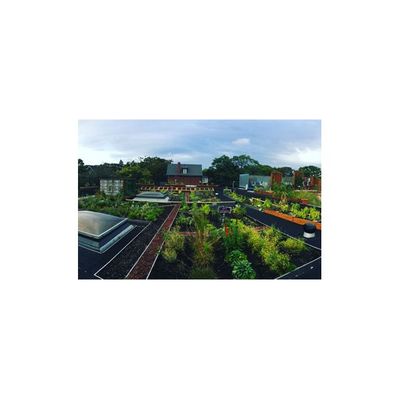
A green roof system is an extension of the existing roof which involves, at a minimum, high quality water-proofing, root repellent system, drainage system, filter cloth, a lightweight growing medium, and plants.
Green roof systems may be modular, with drainage layers, filter cloth, growing media, and plants already prepared in movable, often interlocking grids, or loose laid/built-up whereby each component of the system may be installed separately. Green roof development involves the creation of "contained" green space on top of a human-made structure. This green space could be below, at, or above grade, but in all cases it exists separate from the ground. Green roofs can provide a wide range of public and private benefits and have been successfully installed in countries around the world.
In North America, the benefits of green roof technologies are poorly understood and the market remains immature, despite the efforts of industry leaders. In Europe however, these technologies have become very well established. This has been the direct result of government legislation and financial support. Such support recognizes the many tangible and intangible public benefits of green roofs. This support has led to the creation of a vibrant, multi-million dollar market for green roof products and services in Germany, France, Austria, and Switzerland, among others.
Green roof technologies not only provide the owners of buildings with a proven return on investment, but also represent opportunities for significant social, economic, and environmental benefits, particularly in cities.
Green roofs offer many public, private, and design-based benefits.
Please note: while there are similarities among green roofs, each installation is unique. Hence, all technical performance details provided will vary by region, climate, building, design, and green wall type. GRHC members are an excellence source of green roof expertise, and a resource manual is available from GRHC`s Green Infrastructure Store.
Aesthetic Improvements
- Urban greening has long been promoted as an easy and effective strategy for beautifying the built environment and increasing investment opportunity
Waste Diversion
- Green roofs can contribute to landfill diversion by:
- Prolonging the life of waterproofing membranes, reducing associated waste
- Using recycled materials in the growing medium
- Prolonging the service life of heating, ventilation, and HVAC systems through decreased use
Stormwater Management
- With green roofs, water is stored by the substrate and then taken up by the plants from where it is returned to the atmosphere through transpiration and evaporation
- In summer, green roofs can retain 70-90% of the precipitation that falls on them
- In winter, green roofs can retain between 25-40% of the precipitation that falls on them
- Green Roofs not only retain rainwater, but also moderate the temperature of the water and act as natural filters for any of the water that happens to run off
- Green roofs reduce the amount of stormwater runoff and also delay the time at which runoff occurs, resulting in decreased stress on sewer systems at peak flow periods
Moderation of Urban Heat Island Effect
- Through the daily dew and evaporation cycle, plants on vertical and horizontal surfaces are able to cool cities during hot summer months and reduce the Urban Heat Island (UHI) effect. The light absorbed by vegetation would otherwise be converted into heat energy.
- UHI is also mitigated by the covering some of the hottest surfaces in the urban environment - black rooftops.
- Green roofs can also help reduce the distribution of dust and particulate matter throughout the city, as well as the production of smog. This can play a role in reducing greenhouse gas emissions and adapting urban areas to a future climate with warmer summers.
Improved Air Quality
- The plants on green roofs can capture airborne pollutants, atmospheric deposition, and also filter noxious gases.
- The temperature moderating effects of green roofs can reduce demand on power plants, and potentially decrease the amount of CO2 and other polluting by-products being released into the air.
New Amenity Spaces
Green roofs help to reach the principles of smart growth and positively affect the urban environment by increasing amenity and green space and reducing community resistance to infill projects. Green roofs can serve any number of functions and uses, including:
- Community gardens (e.g. local food production or co-ops)
- Commercial space (e.g. display areas and restaurant terraces)
- Recreational space (e.g. lawn bowling and children`s playgrounds)
Local Job Creation
- The growth of green roof markets gives new job opportunities related to manufacturing, plant growth, design, installation, and maintenance.
- American Rivers suggests that a USD $10B investment could create 190,000 jobs by building 48.5 billion-square-feet of green roof area, or just one percent of the United States` roof space in every community over 50,000 in population.
- There is significant potential for new growth in dense urban areas that were previously unusable.
Energy Efficiency
- The greater insulation offered by green roofs can reduce the amount of energy needed to moderate the temperature of a building, as roofs are the site of the greatest heat loss in the winter and the hottest temperatures in the summer.
- For example, research published by the National Research Council of Canada found that an extensive green roof reduced the daily energy demand for air conditioning in the summer by over 75% (Liu 2003).
Increased Roofing Membrane Durability
- The presence of a green roof decreases the exposure of waterproofing membranes to large temperature fluctuations, that can cause micro-tearing, and ultraviolet radiation.
Fire Retardation
- Green roofs have much lower burning heat load (the heat generated when a substance burns) than do conventional roofs (Koehler 2004).
Reduction of Electromagnetic Radiation
- Green roofs are capable of reducing electromagnetic radiation penetration by 99.4% (Herman 2003).
Noise Reduction
- Green roofs have excellent noise attenuation, especially for low frequency sounds. An extensive green roof can reduce sound from outside by 40 decibels, while an intensive green roof can reduce sound by 46-50 decibels (Peck et al. 1999).
Marketing
- Green roofs can increase a building`s marketability. They are an easily identifiable symbol of the green building movement and can act as an incentive to those interested in the multiple benefits offered by green roofs.
- Green roofs, as part of the green building movement, have been identified as facilitating (Wilson 2005)
- Sales
- Lease-outs
- Increased property value due to increased efficiency
- Easier employee recruiting
- Lower employee and tenant turnover
Increased Biodiversity
- Green roofs can sustain a variety of plants and invertebrates, and provide habitat for various bird species. By acting as a stepping stone habitat for migrating birds they can link species together that would otherwise be fragmented.
- Increasing biodiversity can positively affect three realms:
- Ecosystem
- Diverse ecosystems are better able to maintain high levels of productivity during periods of environmental variation than those with fewer species.
- Economic
- Stabilized ecosystems ensure the delivery of ecological goods (e.g. food, construction materials, medicinal plants) and services (e.g. maintain hydrological cycles, cleanse water and air, store and cycle nutrients)
- Social
- Visual and environmental diversity can have positive impacts on community and psychological well-being
- Ecosystem
Improved Health and Well-Being
- The reduced pollution and increased water quality that green roofs provide can decrease demands for healthcare.
- Green roofs can serve as community hubs, increasing social cohesion, sense of community, and public safety.
Urban Agriculture
- Using green roofs as the site for an urban agriculture project can reduce a community`s footprint through the creation of a local food system.
- These projects can serve as a source of community empowerment, give increased feelings of self-reliance, and improve levels of nutrition.
Educational Opportunities
- Green roofs on educational facilities can provide an easily accessible site to teach students and visitors about biology, green roof technology, and the benefits of green roofs.