


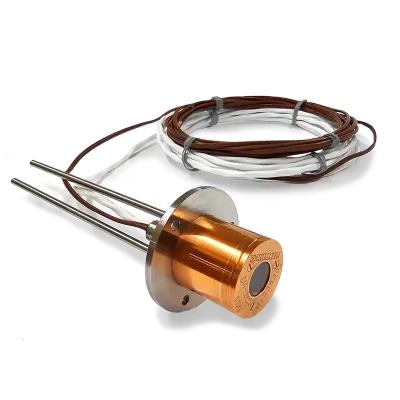
Raptor Scientific 64 Series Heat Flux Transducers offer dependable direct measurement of heat transfer rates in a variety of applications due to careful design, rugged quality construction and versatile mounting configurations. Each transducer will provide a self-generated 10-millivolt (nominal) output at the design heat flux level. Continuous readings from zero to 150% design heat flux are made with infinite resolution. The linear transducer output is directly proportional to the net heat transfer rate absorbed by the sensor.
64 Series transducers are of two basic sensor types, the Gardon type sensor, standard in the ranges from 5 to 4000 Btu/(ft²⋅s), and the Schmidt-Boelter thermopile type sensor, standard in the 0.2 to 4 Btu/(ft²⋅s) ranges. In both type sensors heat flux is absorbed at the sensor surface and is transferred to an integral heat sink that remains at a different temperature than the sensor surface. The difference in temperature between two selected points along the path of the heat flow from the sensor to the sink is a function of the heat being transferred, and a function of the net absorbed heat flux. At two such points, our transducers have thermocouples/thermopiles to form a differential thermoelectric circuit, thus providing a self-generated emf at the output leads that is directly proportional to the heat transfer rate. No power supply or thermoelectric reference junction is needed.
Gardon gages absorb heat in a thin metallic circular foil and transfer the heat radially (parallel to the absorbing surface) to the heat sink welded around the periphery of the foil. The emf output is generated by a single differential thermocouple between the foil center temperature and foil edge temperature.
Schmidt-Boelter gages absorb the heat at one surface and transfer the heat in a direction normal to the absorbing surface. The emf output is generated by a multi-junction thermopile responding to the difference in temperature between the surface and a plane beneath the surface. The Schmidt-Boelter thermopile sensor is always used below 5 Btu/(ft²⋅s). It can be optionally specified up to 100 Btu/(ft²⋅s).
64 Series transducers have met thousands of application challenges in ground and flight aerospace testing, fire testing, flammability heat flux standards, heat transfer research, materials development, and furnace development.