

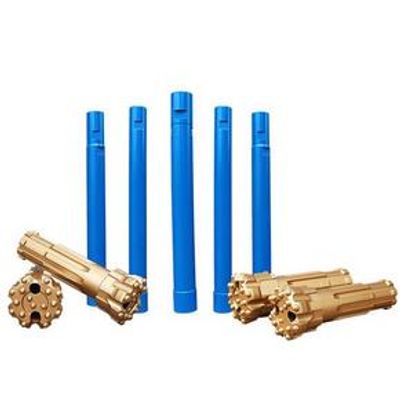
Heijingang - Mining Exploration Reverse Circulation Hammer and Bits
RC Hammer and bits are widely used for exploration drilling.
RC Drilling Greenfield Vs Brownfield Exploration
Mining is one of Australia’s most important industries, but have you found yourself wondering how new mine sites are found?
There are two broad strategies for locating new prospective mining sites: greenfield vs brownfield exploration.
Read on to learn what they are, their pros and cons, and which, if either, is the better strategy.
What Are The Greenfield And Brownfield Strategies?
Greenfield exploration, also referred to as grassroots exploration, is when new mine sites are located in unexplored or currently undeveloped areas. Ore genesis models are used to predict where mineral deposits can be found. Then, the site is surveyed properly to confirm or disprove the presence of the deposit.
Brownfield exploration involves searching known or currently mined sites for additional deposits. Because the sites have already been surveyed, this process is usually very straightforward.
Pros Of Greenfield Exploration
Ore isn’t renewable. Every mine will eventually be depleted which means new mines need to be founded to maintain a stable industry. Of the two exploration strategies, greenfield is the only one that can locate new sites, as opposed to revealing extensions of current ones.
From an investment point of view, there is also an element of surprise when greenfield exploring. Ore genesis models are predictive, which means you could survey a prospective site and find a much larger deposit than you originally anticipated.
Cons Of Greenfield Exploration
The potential rewards of greenfield exploration don’t come without downsides. Funding exploration into unsurveyed areas is a big gamble. While data may speculate that ore is there, things like the size, quality and accessibility of the deposit won’t be confirmed until the site is inspected. Not to mention, there is always the possibility that the data is wrong and there is no ore there at all.
Even if ore is found, starting a mine from scratch is very costly. The mine site itself needs to be developed, including creating road access and landscaping. Adding to the costs, all of the mining equipment for the entire operation must be transported to the site. This process takes a considerable amount of time. It isn’t unusual for a new site to take a decade before returning on the original investment.
Legally, a brand new mine location may be disputed on environmental or cultural grounds, and other interested parties may even attempt to challenge the claim. These may stall, or even permanently prevent, a mine from being founded.
Pros Of Brownfield Exploration
The greatest benefit of brownfield exploration is the high certainty that the endeavour will be profitable with a fast return on investment. Rather than using speculation, data from the existing mine will already show nearby areas where new deposits or entry points could be formed.
A mine started with the brownfield method can take advantage of the infrastructure that has already been established to support the existing mine. Roads, equipment, even personnel, are already present and just need to be extended to the new site.
Brownfield exploration also mitigates the risk of legal concerns. If the site of the original mine has already been cleared for approval, it is unlikely that a new site within the same area would unearth unforeseen issues.
All of these positives combine to make brownfield exploration a fast and effective way to source and maintain revenue.
Cons Of Brownfield Exploration
Brownfield exploration is a brilliant short term way to generate safe revenue, but if a mine is nearing depletion, greenfield strategies need to be employed. It’s important to recognise when a site has reached its potential and look further afield.
Which Is Better?
Unfortunately, the answer isn’t as simple as just choosing one or the other. Both are essential to a healthy mining industry.
If you think of mines as having a life cycle, in the early to mid-life phase, brownfield exploration is preferable because it is the fastest and most cost effective way to access more ore.
In the long term, however, as the mine’s output slows, it is essential that greenfield exploration is occurring to find new, prospective sites. Given the extended time it takes to find, establish and develop a new mine, greenfield exploration needs to occur in advance of the brownfield-sourced mines becoming depleted.
It’s also important for Australia’s greenfield industry to stay consistent because it is a big indicator of the viability of mining as an investment for foreign parties. Low greenfield expedition rates can suggest that Australia’s mining efforts are being slowed by legislation, red-tape, and strict environmental laws.
BD Drill RC Tools
BD Drill produce high quality and stable RC hammers and bits, the sizes ranges from 3" to 12", also can customize the tools for your unique needs, we already supplied products to world-famous RC contractors and many big mine sites.
RC series reverse circulation DTH Hammer is the latest developed product of our company. It is mainly used for deep exploration drilling and stope ore grade control.
It has the following characteristics:
- Based on previous experience of ordinary hammers, combined with the features of reverse circulation hammer, optimized internal structure and ideal energy transfer, thus ensuring the series of hammers drilling with fast smooth and continuous sampling.
- The internal structure is very simple with components of high rigidity, thus ensuring long life and easy maintenance of the hammer.
- The collection tube adopts an integrative design and can be replaced without disassembling the hammer. With carburizing treatment, it has good abrasive resistance.
- Equipped with bits designed with patent. Simply by replacing the drill bit, the same hammer can drill holes of different sizes ensuring that the sample is not contaminated.
- In difficult condition such as loose soil, hard rock and plenty of water exists, sampling can be done well.
RC drilling, referred to as “ Centre Sample Recovery” or “Dual Wall Drilling”, employs a Dual Wall pipe where the drilling medium, normally high pressure air, is the passed between the outer and inner tubes down to the face of the drilling bit where it is returned up the centre tube along with the sample cut by the drill bit.
No contamination
The RC system collects sample through the recovery holes in the face of the drill bit immediately as the cuttings or sample is formed. The drilled sample does not have to travel the length of the hammer where contamination and loss of sample takes place.
Higher Production
In broken and fractured ground conditions, the RC has more higher penetration rates than the conventional hammer.
Dry Sample
Even in certain water bearing strata, it is still possible to collect a dry sample because the cuttings are collected as they are formed through the face of the drill bit.
Higher Sample Recovery
Because the sample is collected through the face of the drill bit, there is no loss of sample when drilling through broken or fractured ground. And since the bit matched to the chuck size, there is very little bypass of sample and recovery rates of up to 98% are generally achievable.