


- Home
- Companies
- HFiltration S.r.l.
- Products
- HFiltration - Bio Filters
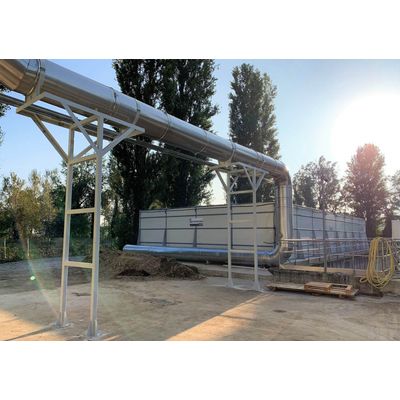
HFiltration - Bio Filters
Biofiltration is a technology by which the gaseous emissions to be treated are conveyed through a biologically active porous medium. This is nothing more than a sort of bed made up of materials such as bark, shredded wood, mature compost, and peat kept at constant temperature and humidity conditions and colonized by aerobic microorganisms capable of degrading the compounds to be treated present in the airstream. It is important to emphasize that colonization and metabolic activities occur within the biofilm which, in this case, is the water film that is created around the particles of the solid part of which the biofilter is made. Before leaving the filter bed, the airstream is enriched with carbon dioxide, of the others volatile organic compounds produced and the heat generated by biochemical reactions.
With biofiltration, modular or compact, it is possible to abate VOCs and reduced sulfur and nitrogen compounds which are degraded both as primary substrates and as metabolites.
In order to obtain a good efficiency of the biofilter, the substances to be removed must have two fundamental characteristics:
- Easy biodegradability
- Non-toxic to microorganisms.
VOC abatement with biological systems can be very effective in several cases, as well as the elimination of the odorous component which can often be completely eliminated. The leachates that form from the biofilter are typically modest and must be contained and conveyed to the appropriate disposal plant.
From a constructive point of view, biofilters have the following components:
- Containment structure
- Air diffusion system
- Filtering bed
- System for maintaining the humidity of the bed.
The basic construction technology is very simple and there are relatively few design and operational variables that affect its proper functioning.
In terms of sizing, the following features are important:
- Specific surface load
- Specific volumetric load
- Average residence time
- Volumetric load
- Removal ability
- Height of the bed.
- Modularity
- Environmental impact close to zero
- Natural filling material
- Low cost of filling material
- Almost zero disposal cost
- Long lifetime
- High efficiency with air purification over 90%
- Reduced investment and maintenance costs