

AL Gummi - High-quality Inflatable Seals
AL Gummi + Kunststofftechnik specializes in the production of inflatable seals crafted from high-quality elastomers and silicone in Germany. These seals are engineered to stringent specifications to meet diverse industrial demands. Available in various designs, including round, stretched, or rectangular, and reinforced with fabric for specialized applications, they offer solutions for situations where static seals fall short. With 75 silicone profiles and 25 additional elastomer variants, these seals provide a versatile sealing option, especially when non-contact sealing is required. Inflatable seals are indispensable in applications requiring airtight closure, such as in pharmaceutical isolators or sterilisers. AL Gummi`s expertise extends to customizing seals with features like chemical resistance and FDA compliance, ensuring suitability across multiple sectors like medical technology, food and beverage, and hazardous material handling.
Our seals are made of silicone and other common elastomers. We currently have 75 different profiles made of silicone and 25 profiles made of other high-quality elastomers in our standard programme.
Inflatable seals are often used where the possibilities of static seals are exhausted. We offer solutions through the use of different profile geometries and targeted material selection.
For example, inflatable seals are the right choice when a non-contact seal is advantageous in the closing or opening process.
Different terms are used for inflatable seals, depending on the supplier or even the region. The terms pneumatic seal, inflatable hollow chamber seal, expansion seal, roll-out seal, expansion seal, pneumatically activated profile, inflatable seal, airseal, pneuma seal or techmembrane are often used.
All these terms are synonyms for the inflatable seal.
Inflatable sealin round design
Extruded hollow profiles are cold or hot vulcanised endlessly into rings. In addition, we install a connection piece or a valve for the media inlet.
With this production technology, the possible bending radii depend on the profile cross-section.
For most applications of inflatable seals, ring-shaped or polygonal (corner areas with radius without exception) seals can help.
For special solutions with deviating bending radii, we can also manufacture your seals as moulded articles.
Inflatable seals in straight version
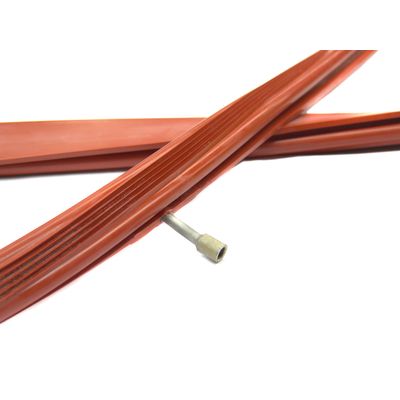
For the straight version, we vulcanise end plugs into the hollow profiles. The end plugs usually have a length of 20 to 30 mm. In addition, we install a connection piece or a valve for the media inlet. It is also possible to vulcanise the air connection into the end pieces.
We recommend to secure the two ends mechanically as well. This prevents the seal from being pressed out or pulled out. At the same time, such a measure extends the durability of the seal.
For the optimal design of your seal, please contact our team, which will be happy to help you select a material or the right profile cross-section.
Inflatable seals with corners
We also manufacture inflatable frame seals with rounded or even 90° corners.
Inflatable frame gaskets with mitre joints regularly have high error rates. For this reason, AL Gummi + Kunststofftechnik offers square inflatable gaskets only with shaped pieces.
If uniform expansion throughout is a prerequisite for axial sealing, moulded vulcanised corners can be incorporated into the seal. In this case, the straight side parts made of pre-extruded profile are joined together by directly vulcanising the corners.
In case of radial expansion inwards or outwards, we recommend using polygonal inflatable gaskets. The radii of curvature of the profiles are decisive here. If a tighter rounding of the mould is desired, we can alternatively manufacture inflatable seals with rounded mould corners.
Another frequently used variant is inflatable seals in a U-shape. Our U-shaped seals inflate radially inwards or outwards, or seal axially upwards or downwards.
Structure and functionof inflatable seals
As a rule, inflatable seals consist of an extruded hollow profile with an air connection. In particularly demanding cases, inflatable seals can also be manufactured as moulded articles. For activation, pressure is applied to the profile, which leads to expansion of the seal in a defined direction.
In addition to their use as seals, inflatable seals can also perform other functions. They can be used to solve problems that occur when lifting and lowering components. Furthermore, inflatable seals can also be used to clamp and grip elements.
So-called air seals are often used as insulators in applications where airtight sealing is mandatory. This will protect the equipment operator from the contents of the isolator, or more commonly, the process within the equipment from external contamination. Air seals are equally suitable for gloveboxes, entrance doors, transfer and filter systems where toxic or sterile components are handled, as well as for heat, chemical, radiation or filter-based sterilisers.
Hollow sectionscan basically be divided into high-pressure and low-pressure profiles
The low-pressure profiles are characterised by the fact that they are pressurised with relatively low pressure (up to 0.8bar). Low-pressure profiles are selected for bridging large distances and, depending on the profile, can overcome a distance of up to 20 mm. The path of the seal is determined by the geometry. Due to the profile, however, only low contact pressures can be realised. Low-pressure profiles are therefore particularly suitable for sealing larger sealing gaps at low pressures or for lifting low loads.
The high-pressure profiles only bridge small distances. However, they can be subjected to higher pressures
(up to 3 bar). They are expanded to a certain height by means of compressed air and return to their original size when the pressure is released. High-pressure or expansion profiles bridge considerably less distance than low-pressure profiles, but they develop higher contact pressures. Due to their usually strong construction, expansion profiles can be used to seal higher counterpressures than low-pressure profiles and are therefore particularly suitable for lifting, clamping or holding loads.
As a general rule, the smaller the sealing gap selected, the shorter the activation time. If the seals are chambered, higher pressures can also be used, depending on the application.
Blowing direction
The blowing direction is important for the optimal effect of the inflatable seal. The best clamping effect is achieved with a profile that seals radially outwards. We distinguish between three cases: