


- Home
- Companies
- ALA Scientific Instruments, Inc.
- Products
- ALA - Model HSPC-2-SB - High Speed ...
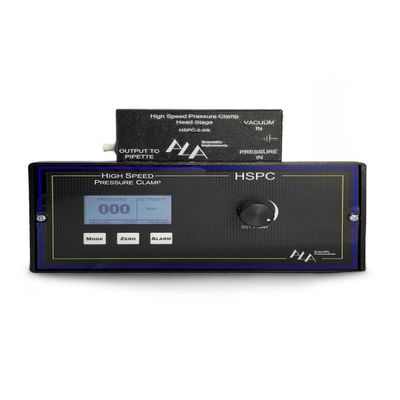
ALA - Model HSPC-2-SB -High Speed Pressure Clamp
The HSPC-2-SB is an easy-to-use device for generating arbitrary pressure waveforms for the study of mechanosensitive ion channels during patch clamp recording. It is also used to stimulate the inner hair cells in the ear canal. The device consists of a control unit and a small headstage. If you study mechanosensitive channels or stimulate inner hair cells, then you need ALA’s High Speed Pressure Clamp, HSPC-2-SB. The HSPC-2-SB is the only commercial instrument that can generate reproducible and rapid pressure/vacuum steps. Adding the HSPC-2-SB and the PV-Pump accessory to any patch clamp rig creates a complete system for biophysical studies in this important area.
The HSPC-2-SB is an easy-to-use device for generating arbitrary pressure waveforms for the study of mechanosensitive ion channels during patch clamp recording. It is also used to stimulate the inner hair cells in the ear canal. The device consists of a control unit and a small headstage.
If you study mechanosensitive channels or stimulate inner hair cells, then you need ALA’s High Speed Pressure Clamp, HSPC-2-SB. The HSPC-2-SB is the only commercial instrument that can generate reproducible and rapid pressure/vacuum steps. Adding the HSPC-2-SB and the PV-Pump accessory to any patch clamp rig creates a complete system for biophysical studies in this important area.
The 2nd generation High Speed Pressure Clamp (HSPC-2SB) device is a closed loop pressure-control servo optimized to deliver vacuum and pressure at zero average flow. Although the device is targeted at patch clamp applications, response characteristics are fully adjustable for use in other experimental environments. It features a steady state pressure range of ±200 mmHg, hardware to prevent water entering the control valve, an external command input and a buffered output pressure monitor. Command response has been optimized for steps as large as +/-200 mmHg. Pressure rise time is amplitude dependent and varies from 6 to 8 ms for a 20 mmHg step to 15 ms to 20 ms for a 200 mmHg step approximately. Fall time is also amplitude dependent and varies from 6 to 8 ms for a 20 mmHg step to 15 ms to 20 ms for a 200 mmHg step approximately. There is an amplitude independent delay of 1 ms on both the rising and falling edges of the response. System noise measured at the pressure sensor output is +/-0.5 mmHg peak to peak.
HSPC-2-SB System Highlights
• Pressure and vacuum partitioned by small headstage that easily mounts near amplifier probe
• Simple connection to electrode holder transmits pressure/vacuum pulses
• Command input of 20mV/mmHg sets pressure
• Pressure output of 20mV/mmHg signal monitor or from LCD display
• Moisture sensor prolongs life of headstage
• Compatible with all major patch clamp hardware/software
• Improves consistency of establishing gigaseals and whole-cell configuration
P-V Pump:
| Voltage | 115V AC or 230V AC |
| Maximum Airflow | 0.12 cfm / 3 l/min |
| Maximum Vacuum | 17.5 in”Hg / 592 mbar |
| Frequency | 60 Hz / 50 Hz |
| Noise Leve | 40 dB(A) Max. @ 1 meter |
| Recognition | UL / CE |
| Dimensions | 32cmx10cmx15cm ht. |
| Weight | 3.4Kg |
| Max. Input Pressure/Vacuum | +/-7psi; 362mmHg |
| Standard Output Pressure/Vacuum Range | +/-200mmHg |
| Noise | +/-10mV; +/-1mmHg |
| Power | 9V dc, 1A fuse |
| Controller | 2.9lbs/1.32kg – 8.5”/21.6cm x 7.5”/19cm x 4”/10cm |
| Headstage | 0.5lbs/0.23kg – 3.75”/9.5cm x 1.75”/4.4cm x 1.75”/4.4cm |
| Typical Speed of Response | 0 to 100mmHg jump in 12ms: 0 to 100% settling time Command Input 20mV/mmHg |
| Command Input | 20mV/mmHg |
| Monitor Output | 20mV/mmHg |
| Set Point Control (Holding Pressure/Vacuum offset control) | +/-200mmHg |
| Moisture Alarm | Capacitance liquid detection sensor to protect valve |
| HSPC-2-SB | Complete pressure clamp system includes controller, piezo valve headstage and cable, misc. tubing, and fittings |
| PV-Pump | Pressure / vacuum pumps with output tubing |
The Mechanosensitive Ion Channel Piezo Inhibits Axon Regeneration
Trabecular Meshwork TREK-1 Channels Function as Polymodal Integrators of Pressure and pH
Sphingomyelinase disables Piezo1 channel inactivation to enable sustained response to mechanical force
The Piezo2 ion channel is mechanically activated by low-threshold positive pressure
Disruption of Membrane Cholesterol Organization Impairs the Activity of PIEZO1 Channel Clusters
The Transfer Characteristics of Hair Cells Encoding Mechanical Stimuli in the Lateral Line of Zebrafish
Piezo-like Gene Regulates Locomotion in Drosophila Larvae
A hydrophobic gate in the inner pore helix is the major determinant of inactivation in mechanosensitive Piezo channels
Kern, D. M., Sorum, B., Hoel, C. M., Sridharan, S., Remis, J. P., Toso, D. B., & Brohawn, S. G. (2020). Cryo-EM structure of the SARS-CoV-2 3a ion channel in lipid nanodiscs. bioRxiv : the preprint server for biology, 2020.06.17.156554. https://doi.org/10.1101/2020.06.17.156554
Fogerty, J., Stepanyan, R., Cianciolo, L.T. et al. Genomic non-redundancy of the mir-183/96/182 cluster and its requirement for hair cell maintenance. Sci Rep 9, 10302 (2019). https://doi.org/10.1038/s41598-019-46593-y
Darkow E, Rog-Zielinska EA, Madl J, Brandel A, Siukstaite L, Omidvar R, Kohl P, Ravens U, Römer W and Peyronnet R (2020) The Lectin LecA Sensitizes the Human Stretch-Activated Channel TREK-1 but Not Piezo1 and Binds Selectively to Cardiac Non-myocytes. Front. Physiol. 11:457. doi: 10.3389/fphys.2020.00457
Besch, S.R., et al., (2002). High-speed pressure clamp. Pflügers Arch. 445, 161-166.
Suchyna, T., et al., (2004). Dynamic regulation of mechanosensitive channels: capacitance used to monitor patch tension in real time. Phys. Biol. 1,1–18.
Gomis, A., et al. (2008) Hypoosmotic- and pressure-induced membrane stretch activate TRPC5 channels. J Physiol 586.23, 5633–5649.
Coste, B., et al., (2012) Piezo proteins are pore-forming subunitsNof mechanically activated channels. Nature, Vol 483, 176-181.
Sukharev, S. (2010) Piezo proteins are pore-forming subunits of mechanically actived channels. Nature.
Vargo, J.W., et al. (2017). Inhibition of Mitochondrial Division Attenuates Cisplatin-Induced Toxicity in the Neuromast Hair Cells. Frontiers in Cellular Neuroscience, Vol. 11, Article 393.