

- Home
- Companies
- Nanjing Hjchem Equipment Co.,Ltd
- Products
- Hjchem - Automated Solid Phase Peptide ...
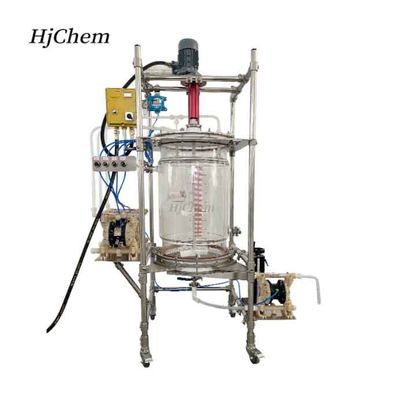
Hjchem - Automated Solid Phase Peptide Synthesizer
Solid-phase peptide synthesizer automates the sequential addition of amino acids to a growing peptide chain anchored to a solid resin support. This method, known as solid-phase peptide synthesis(SPPS), significantly enhances the efficiency and accuracy of peptide production.1. Volume: 100ml, 200ml, 500ml, 1L, 2L, 3L, 5L, 10L, 20L, 30L, 50L, 100L, form laboratory scale to pilot plant and industrial scale.
2. Vessel: Single wall, double wall or triple wall available
3. Working pressure: Full vacuum to 0.05/0.1Mpa
4. Working temperature: -80°C ~ +220°C
5. Wetted parts: Borosilicate glass 3.3, PTFE
6. Filter device: PTFE, glass or stainless-steel, pore size 0.1um to 200um
1. Reaction Vessel
1.1 The reaction vessel serves as the central chamber where peptide synthesis occurs.
1.2 Typically made from inert materials like borosilicate glass or stainless steel, the reaction vessel ensures chemical resistance and durability.
1.3 Within this vessel, the resin, which acts as the solid support, is housed. It design allows for easy mixing and washing, crucial for successful synthesis.
2. Resin
2.1 The resin is a crucial component as it anchors the first amino acid and supports the growing peptide chain throughout the synthesis process.
2.2 The resin’s properties significantly influence the efficiency and yield of the peptide synthesis.
3. Reagent Delivery System
3.1 A precise reagent delivery system is essential for accurately dispensing amino acids, coupling reagents, deprotection agents, and solvents into the reaction vessel.
3.2 Automated pumps and valves control the flow of these reagents, ensuring that each step of the synthesis process is executed with high precision.
4. Mixing and Agitation Mechanism
4.1 Effective mixing is vital to ensure uniform distribution of reagents and optimal contact with the resin.
4.2 Solid-phase peptide synthesizers often incorporate magnetic stirrers or mechanical agitators to achieve this.
4.3 Proper mixing and agitation prevent incomplete reactions and enhance the overall efficiency of the synthesis process.
5. Temperature Control System
5.1 Maintaining the appropriate temperature is crucial for the success of peptide synthesis.
5.2 Many reactions, such as coupling and deprotection, require specific temperature conditions.
5.3 A temperature control system, which includes heating or cooling jackets, ensures that the reaction vessel maintains the desired temperature throughout the synthesis process.
6. Filtration System
6.1 After each synthesis step, washing the resin is necessary to remove excess reagents and by-products.
6.2 The filtration system, typically involving built-in filters and wash ports, facilitates this process.
6.3 Efficient filtration prevents contamination and ensures that each reaction proceeds with high purity.
7. Control Unit
7.1 The control unit is the brain of the solid-phase peptide synthesizer. This computerized system manages the entire synthesis process, from reagent addition to temperature control and mixing.
7.2 Programmable protocols allow for the automation of complex synthesis sequences, reducing manual intervention and minimizing errors.
For more information, please visit us:
Automated Solid Phase Peptide Synthesizer
https://njhjchem.com/product/glass-nutsche-filters/automated-solid-phase-peptide-synthesizer/