


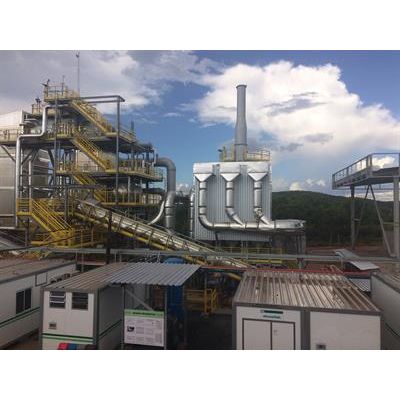
Hurricane - Cyclone Systems
Cyclones have been mostly designed and improved by empirical means. Computerized Flow Dynamics (CFD) can be used for partial cyclone optimization but it is still incomplete for full cyclone optimization. The fact that particle agglomeration for cyclone modelling has been disregarded until present days is one of the reasons for notably low collection efficiency results. This knowledge has helped ACS build very accurate models of efficiency prediction, capable of explaining why sub-micrometer particles are often captured with much higher efficiency than expected. Particles tend to form bigger agglomerates (clusters) much easier to collect than the original particles.
Agglomeration increases in the presence of wide particle size distributions, long residence times in the cyclone and high inlet particle concentrations. This has been incorporated in ACS numerical simulation tool, combining a sophisticated stochastic algorithm with a classical numerical model to predict cyclone performance: the PACyc (Particle Agglomeration in Cyclones) model.
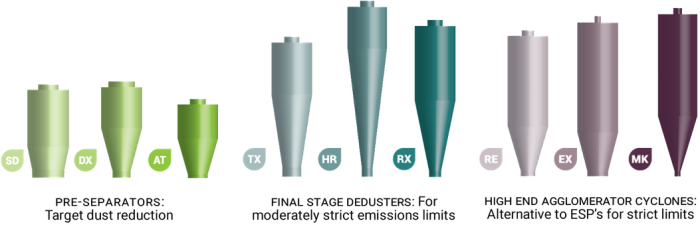
ACS developed a complete line of very different Hurricane cyclone families for each different need, considering how inter-particle agglomeration / clustering affects collection efficiency. From coarse particle pre-separation proportioned by compact and low pressure drop cyclones, such as the SD and DX lines, to fine particulate capture with high-end geometries such as the EX and MK, ACS provides solutions for a wide range of industrial cases, being able to reach emissions comparable to ESPs (down to less than 30mg/Nm3).
- Fuel Oil Combustion
- Steel and Ferroalloys
- Clinker Cooler and Pre-Heater Dedusting
- Pyrolisis, Incineration and Gasification
- Biomass Milling & Drying
- Oil & Gas
- High Temperature Separation & Energy Recovery
- Air Caption & Dedusting
- Calcination Processes
- Biomass and Coal Combustion
- Pharmaceutical Ingredients
- Chemicals
- Food Ingredients
- Mineral Processing
- Fertilizers
- Milling and Drying Processes