


- Home
- Companies
- SPEC Oil & Gas Technologies
- Products
- SPEC - Hydrocarbon Dew Point Control ...
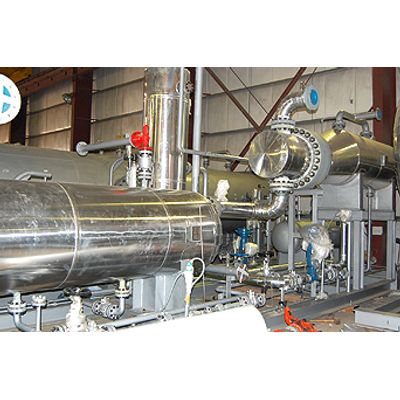
SPEC - Hydrocarbon Dew Point Control Unit
Hydrocarbon dew point refers to the temperature at any pressure range or the pressure at any temperature range where hydrocarbons begin to condense from the gas mixture. At the same temperature, heavier hydrocarbons’ dew point temperature increases as the pressure is reduced. Hydrocarbon dew point control (HCDPC) can be used for the extraction of NGL from gas streams. Depending on the product requirements and the gas stream specifications, SPEC provides customized HCDPC packages to meet our customers’ requirements.
Low Temperature Separation Package
Given sufficient pressure, low temperature separation units can be used for HCDPC. Low temperature separation packages work on the principles of the Joule-Thomson effect—that gases cool when expanded at constant enthalpy from higher pressure to a lower pressure. The cooling of the gases causes hydrocarbons to condense.
Process Description
LTS systems require high pressure gas to be a viable form of HCDPC. High pressure gas enters a heat exchanger coil at the bottom of the separator where the gas is cooled. A high pressure separator removes any water or condensate formation caused by the cooling of the gas. The high pressure gas then passes through a reducing valve where the Joule-Thompson expansion occurs. The hydrocarbon liquid drops to the bottom of the separator while the gas leaving has a dew point equal to the temperature and pressure of the separator. Glycol injection can help prevent hydrates in the event that dehydration units have not been installed upstream.
Major Equipment
- Low Temperature Separator with integrated heating coil
- High Pressure Separator (HPKO)
- Heat Exchanger
- Expansion Valve
Mechanical Refrigeration Package
When sufficient pressures are not available for LTS, mechanical refrigeration can be used for HCDPC and for the removal of hydrocarbons from the gas.
Process Description
The inlet gas passes through a gas/gas heat exchanger where the gas leaving the cold separator cools the warm incoming gas. The inlet gas then heads to a chiller, typically kettle type shell and tube exchanger using propane as the refrigerant. From the chiller the gas and liquid are separated in a three phase separator: Water and glycol (if it was to prevent hydrate formation), liquid hydrocarbon and gas. The liquid hydrocarbon is sent to distillation towers for separation of the liquid hydrocarbon into its individual components. The top gas is used in the gas/gas heat exchanger and then is an outlet gas from the plant.
Process Diagram
Please insert process diagram
Major Equipment
- Gas/Gas Heat exchanger
- Chiller
- Cold Separator
SPEC experienced engineers can help decide which HCDPC process is appropriate for your application.